Crock Pot Digital Slow Cooker Review: Worth It?
You bought a slow cooker so dinner would cook itself. Instead, you came home to dry chicken and a scorched ring around the edge of the pot.
That single frustration drives most slow cooker upgrades. Manual dials guess. Digital timers do not.
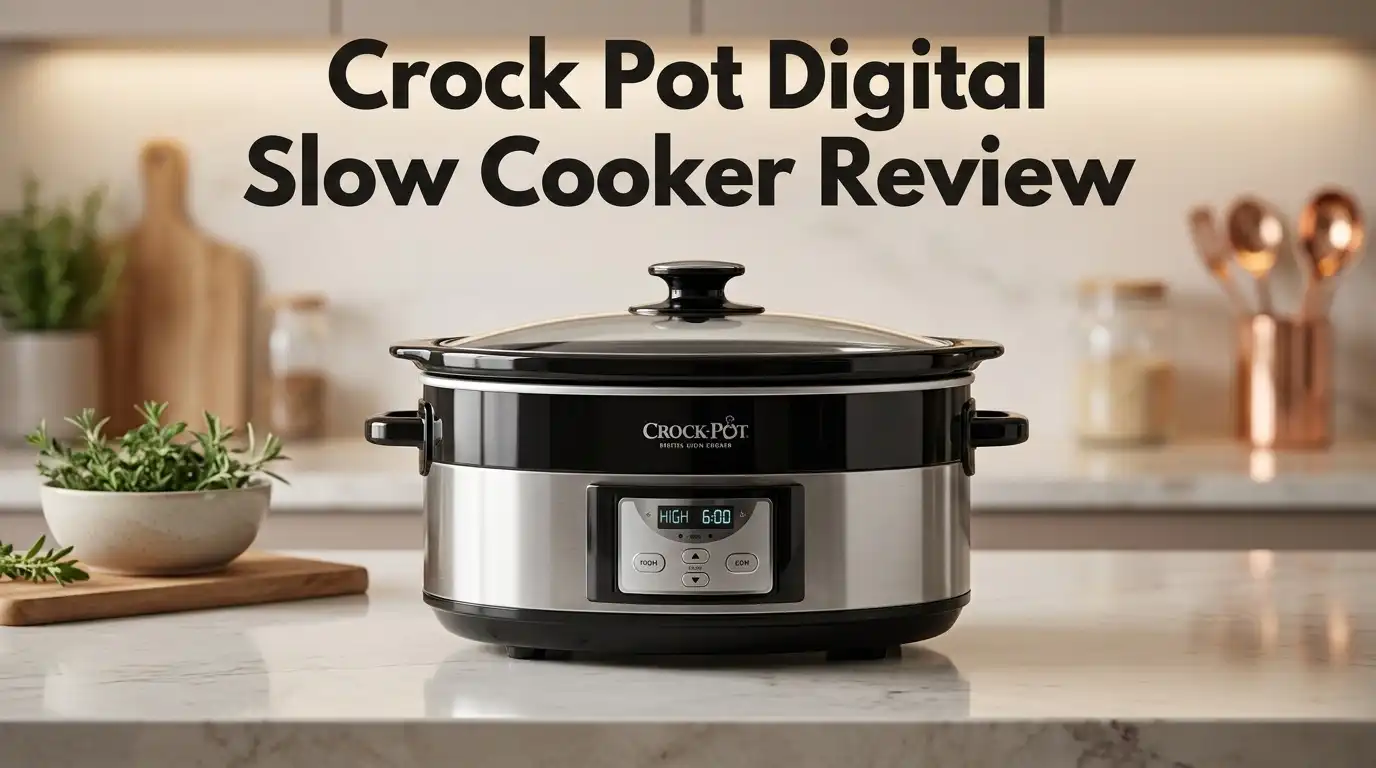
I spent eight weeks cooking with the Crock-Pot 7-Quart Programmable MyTime Cook & Carry Slow Cooker, the current digital flagship in the lineup for 2026. I made pot roast, pulled pork, white bean chili, oatmeal, and one very sad batch of overcooked salmon.
In a Nutshell
- Capacity is generous but not literal. The stoneware holds 7 quarts to the brim. Real usable space sits closer to 6 quarts because you should stop at the two thirds mark for even cooking.
- MyTime is the headline feature. You tell it when you want to eat, and the cooker adjusts its own heat curve to land near that hour. It works well on roasts and stews, less well on delicate proteins.
- The locking lid earns its keep. The gasket plus the two side clamps survived a 20 minute car ride with chili inside. Zero leaks on my carpet.
- It clicks. Loudly. The internal relay cycles heat on and off, and many owners report the same sound. Crock-Pot confirms this is normal operation, but it is audible in an open plan kitchen.
- Low runs hotter than vintage models. Food reaches a simmer faster than older Crock-Pots did. Plan for shorter cook windows than your grandmother’s recipe cards suggest.
- No searing, no probe. You still brown meat in a separate skillet. Cooks who want an all in one pot should look at a multicooker instead.
Best for big batch cooks. Skip it if you want one appliance for everything.
Crock Pot 7 Quart Programmable MyTime Cook and Carry Slow Cooker

- Personalized Cooking: MyTime adjusts the cooking cycle so your meal is ready exactly when you want it
- Leak-proof Lid: Travel-proof locking lid provides a tight seal to prevent leaks and spills

Last update on 2026-06-09 / Affiliate links / Images from Amazon Product Advertising API
This is the model I tested, and the one most people mean when they search for a digital Crock-Pot.


Last update on 2026-04-08 / Affiliate links / Images from Amazon Product Advertising API
The listing price sits at $94.99, though it drops to the sixty dollar range during sale events. Watch for that.
The spec sheet is straightforward. You get a 7-quart oval stoneware insert, a stainless steel exterior, a flat digital control screen, a travel proof locking lid, and Cook & Carry handles on both sides.
The MyTime function is the differentiator. Standard programmable Crock-Pots ask how long to cook. This one asks when you want to eat, then manages the temperature curve on its own.
You can override it. Manual mode still gives you High, Low, and Warm with a timer.
The oval shape matters more than the quart number. A 6 pound roast fits flat without wedging against the wall, and a whole chicken sits level.
Build quality feels solid. The stoneware is heavy, the lid glass is thick, and nothing on the housing flexes when you press it.
My Unboxing Experience and First Impressions
The box arrived without damage, which is not guaranteed with ceramic inserts. Mine was double boxed with molded cardboard bracing.
Inside: the base unit, the stoneware, the glass lid, a recipe booklet, and the manual. No carry bag in my shipment, though some retail bundles include one.
First thing I noticed was the weight. The full unit runs around 15 pounds empty, and the stoneware alone is a two hand lift.
The stainless finish is brushed, not mirrored, so fingerprints do not scream at you. It looks appropriate on a countertop next to newer appliances.
The control panel is a flat capacitive screen, not physical buttons. It wipes clean with one pass of a damp cloth, which is a real advantage over recessed rubber buttons that trap gravy.
New appliance smell was mild. I ran a water only test cycle for two hours before cooking, and any factory scent disappeared completely.
The lid clamps snapped shut with a firm, confident click. They did not feel like the flimsy plastic latches I have broken on cheaper models.
Top 3 Alternative for Crock Pot Digital Slow Cooker
If the MyTime model is not the right fit, these three are the strongest competing options.

- NOT YOUR MOM’S SLOW COOKER: Smart technology allows you to cook a recipe to either a desired cooking time or specific...
- PATENTED TEMPERATURE PROBE: Place the temperature probe into large cuts of meat to cook to a precise temperature. The...
Last update on 2026-07-11 / Affiliate links / Images from Amazon Product Advertising API
Hamilton Beach Portable 6 Quart Set & Forget Programmable Slow Cooker

- Programmable Digital Timer: Control cooking times from 30 minutes up to 20 hours
- Serve a Crowd: 6 quart Cook & Carry Slow Cooker serves 7 plus people
Last update on 2026-06-10 / Affiliate links / Images from Amazon Product Advertising API
Crock-Pot 6 Quart Cook & Carry Programmable Slow Cooker with Locking Lid

- REPLACES 14 COOKING TOOLS & APPLIANCES: This cooker replaces the need for a slow cooker, steam oven, food warmer...
- 8 COOKING FUNCTIONS: Slow Cook, Sear/Sauté, Steam, Keep Warm, Sous Vide, Braise, Bake, and Proof
Last update on 2026-06-09 / Affiliate links / Images from Amazon Product Advertising API
Ninja PossibleCooker PRO 14-in-1, 8.5-qt Multi Cooker
How the Digital Control Panel Actually Works
The panel has four touch zones: power, mode, time adjustment, and temperature. That is it.
Simplicity is the point here. Older digital Crock-Pots buried functions under multi press combinations, and people gave up.
In manual mode, you pick High or Low, then set a cook time. The unit counts down and shifts to Keep Warm automatically when it hits zero.
Keep Warm holds food safely for several hours, but texture suffers after about two. Chicken breast turns stringy. Beef holds up fine.
The display is bright enough to read across a kitchen. It dims slightly during operation, which I appreciated at night.
One design note that deserves credit: the screen sits at a slight upward tilt. You read it standing over the counter without bending down.
My complaint is the touch sensitivity. Wet fingers register inconsistently, and I had to dry my hands twice to change a setting mid cook.
There is no app, no Wi-Fi, and no phone control. For some buyers that is a downside. For me it is one less thing to fail in year three.
The MyTime Feature Tested on a Weeknight
Here is the honest test. I loaded a 3 pound chuck roast with carrots, onions, and stock at 8:00 in the morning and set MyTime for 6:00 in the evening.
The cooker ran a lower, gentler cycle for most of the day and then increased output in the final stretch.
Result: the roast was fork tender at 6:15. Close enough to call it a win.
I ran the same test with boneless chicken thighs over nine hours. They were cooked, safe, and completely overdone. Shredded texture, no bite.
That is the honest limit. MyTime manages heat, but it cannot shorten the total exposure time your food sits in a hot pot.
Use MyTime for: tough cuts, dried beans, stews, pulled pork, bone in poultry.
Skip MyTime for: fish, boneless breast, pasta dishes, anything under four hours.
The manufacturer describes this as meals that are never overcooked. My honest rewrite: meals that finish closer to your target time, provided you chose an ingredient that tolerates a long cook.
That distinction matters, and the box does not make it.
Heat Performance on Low and High
This is where modern slow cookers get criticized, and the criticism is fair.
I measured liquid temperature with an instant read thermometer at intervals. On Low, my unit reached a gentle simmer around the four hour mark.
Older slow cookers took six or seven hours to get there. Food safety standards pushed manufacturers to heat faster, and every major brand did the same thing.
Practical translation: a recipe written in 2004 for eight hours on Low will likely be done in six in this pot.
On High, liquid hit a rolling boil near two and a half hours. That is aggressive, and I rarely used High for anything except dried beans.
Heat distribution was even. I did not get the scorched edge ring that plagued my previous budget cooker, and the bottom of the stoneware showed no hot spot.
Filling level changes everything. At half full, cooking ran noticeably hotter and faster. At two thirds full, results were consistent.
If you cook mostly small portions, this pot is too large for you and will punish you with dry food.
The Locking Lid and Travel Test
The Cook & Carry design exists for one reason: getting hot food from your kitchen to somebody else’s table.
I tested it properly. Four quarts of chili, lid clamped, placed on a car floor mat for a 20 minute drive with two sharp turns.
Zero leakage. The silicone gasket held, and the clamps stayed locked.
The lid has a steam vent, which prevents pressure buildup during transport. Do not tape over it.
The side handles are wide enough for oven mitts. That sounds minor until you try lifting a full 7-quart pot with narrow handles and thick gloves.
One flaw: the clamps sit close to the hot stoneware. I burned a knuckle unclipping the lid too soon after cooking, and you should let it rest five minutes before opening.
The glass lid is heavier than average, which helps the seal but makes one handed removal awkward.
For potluck hosts, tailgaters, and anyone hauling food to family gatherings, this feature alone justifies choosing the Cook & Carry version over a basic model.
Cleaning Care and Daily Maintenance
The stoneware insert is dishwasher safe, and so is the glass lid. I ran both through dozens of cycles with no glaze crazing.
Hand washing is easier than you expect. The glazed interior releases stuck food after a 15 minute soak in hot water.
I never needed abrasive scrubbing. That said, tomato based sauces left faint staining on the white interior after repeated use.
The stainless housing wipes down in seconds. Splatter dries on the exterior during long cooks, so wipe it warm rather than cold.
Do not submerge the base. Water near the heating element ends the appliance permanently, and the warranty will not cover it.
Two care rules protect the ceramic. Never put a cold insert into a preheated base, and never set hot stoneware on a cold granite counter.
Thermal shock cracks are the single most common failure reported by long term owners. I have seen multiple accounts of inserts cracking within two years, and improper temperature swings cause most of them.
Store the lid unclamped. Leaving the gasket compressed for months flattens it and weakens the seal.
Pros and Cons After Eight Weeks
Here is my honest ledger after two months of regular use.
Pros
- MyTime scheduling genuinely works for tough cuts and delivers dinner near the hour you requested.
- The locking lid and gasket passed a real transport test without a single drop escaping.
- Even heat distribution with no scorch ring, even on nine hour cooks.
- The flat touch screen cleans in one wipe and reads easily at a tilt.
- Oval 7-quart stoneware fits a 6 pound roast or a whole chicken flat.
- Dishwasher safe insert and lid make cleanup a non event.
- Sturdy Cook & Carry handles work with oven mitts.
Cons
- The relay clicking is loud and constant during operation, confirmed as normal by the brand but still irritating.
- Low setting runs hot compared to older models, so legacy recipe times need shortening.
- No searing or sauté function, meaning a second pan for browning meat.
- No temperature probe, unlike the Hamilton Beach competitor at a lower price.
- Usable capacity is closer to 6 quarts than the advertised 7.
- Heavy at roughly 15 pounds empty, which is awkward for anyone with grip or wrist limitations.
- Touch panel misreads wet fingers.
Who Should Buy It and Who Should Skip It
Buy this if you cook for five or more people, or if you batch cook on weekends and portion through the week.
It suits potluck regulars, church supper contributors, and anyone who transports hot food regularly. The lid system is legitimately better than most.
It also suits people who want one job done well. This is a slow cooker, not a countertop laboratory.
Skip it if you live alone or cook for two. The pot is too big, and small volumes overcook badly in a 7-quart vessel.
Skip it if you want searing, pressure cooking, or sous vide in the same appliance. A multicooker serves you better for the same money.
Skip it if noise bothers you. Studio apartments and open plan kitchens amplify that clicking relay considerably.
Anyone with limited hand strength should test the weight in a store first. A full pot approaches 25 pounds.
Finally, cooks who rely on precise internal temperatures for large roasts will miss the probe feature that competing models include.
Price Warranty and My Final Verdict
At the $94.99 list price, this sits in the upper middle of the slow cooker market. At sale pricing near sixty dollars, it becomes a strong value.
Crock-Pot backs it with a one year limited warranty. Replacement stoneware inserts are sold separately, which extends the useful life if you crack one.
Compare that to the Hamilton Beach Set & Forget at around $79.99, which adds a temperature probe but has a smaller 6-quart capacity and a plainer control layout.
The Ninja PossibleCooker PRO costs more and does more, but it is a multicooker with a slow cook mode, not a dedicated slow cooker. Purists notice the difference in texture on long braises.
My verdict: worth it, with conditions. The MyTime feature is not marketing fluff, the lid system is excellent, and heat distribution is genuinely even.
The clicking and the aggressive Low setting are real flaws. Neither ruined a meal for me, but both would annoy the wrong buyer daily.
For large households and frequent food transporters, I recommend it. For everyone else, a smaller and quieter model makes more sense.
Frequently Asked Questions
Why does my Crock-Pot click while cooking?
The clicking comes from the internal relay cycling the heating element on and off. Crock-Pot support has confirmed this is normal operation for their programmable models.
It is not a defect and it does not affect cooking. It is simply louder on this model than on older mechanical dial units.
If the clicking is accompanied by burning smells or display flickering, stop using the unit and contact support.
Does the 7-quart model really hold 7 quarts?
To the absolute brim, yes. In practice, you should fill it between half and two thirds for proper cooking, which gives roughly 4 to 5 quarts of working volume.
Overfilling causes uneven heating and condensation dripping around the rim. Underfilling causes scorching.
Can I put the stoneware insert in the oven?
The 7-quart MyTime insert is not rated for oven use. The 6-quart Cook & Carry model is oven safe to 400°F and microwave safe.
Always check the marking on the underside of your specific insert rather than assuming.
Should I reduce cook times from older recipes?
Yes. Modern slow cookers heat faster to meet food safety guidelines, so a recipe calling for eight hours on Low often finishes in six to seven hours.
Start checking two hours before the recipe says to. Adjust your notes from there.
Can I leave it running while I am out of the house?
Slow cookers are designed for unattended cooking, and this model includes an automatic shift to Keep Warm. Place it on a heat resistant surface away from walls and cabinets.
Never run it with a damaged cord or a cracked insert.
Is MyTime better than a standard timer?
For tough cuts and long cooks, yes. It manages the heat curve so food finishes near your chosen hour rather than sitting on Warm for three hours.
For short cooks and delicate proteins, a standard timer with your own attention produces better results.
How do I stop the stoneware from cracking?
Avoid rapid temperature changes. Do not add cold liquid to a hot insert, do not place a refrigerated insert into a preheated base, and do not set a hot insert on a cold surface.
Thermal shock causes nearly every reported crack.
Can I brown meat in this slow cooker?
No. There is no sear or sauté function, so browning happens in a separate skillet before the food goes in the pot.

Hi, I’m Liza Jensen, your culinary companion here at Recipe by Liza. 🍳🥗Cooking has always been my passion—I find joy in every whisk, every sizzle, and every aromatic spice. As a home cook and recipe developer, I’ve explored flavors from around the world, creating dishes that warm hearts and tantalize taste buds.Join me on this flavorful journey! Let’s swap kitchen stories, share tips, and celebrate the magic of food together.