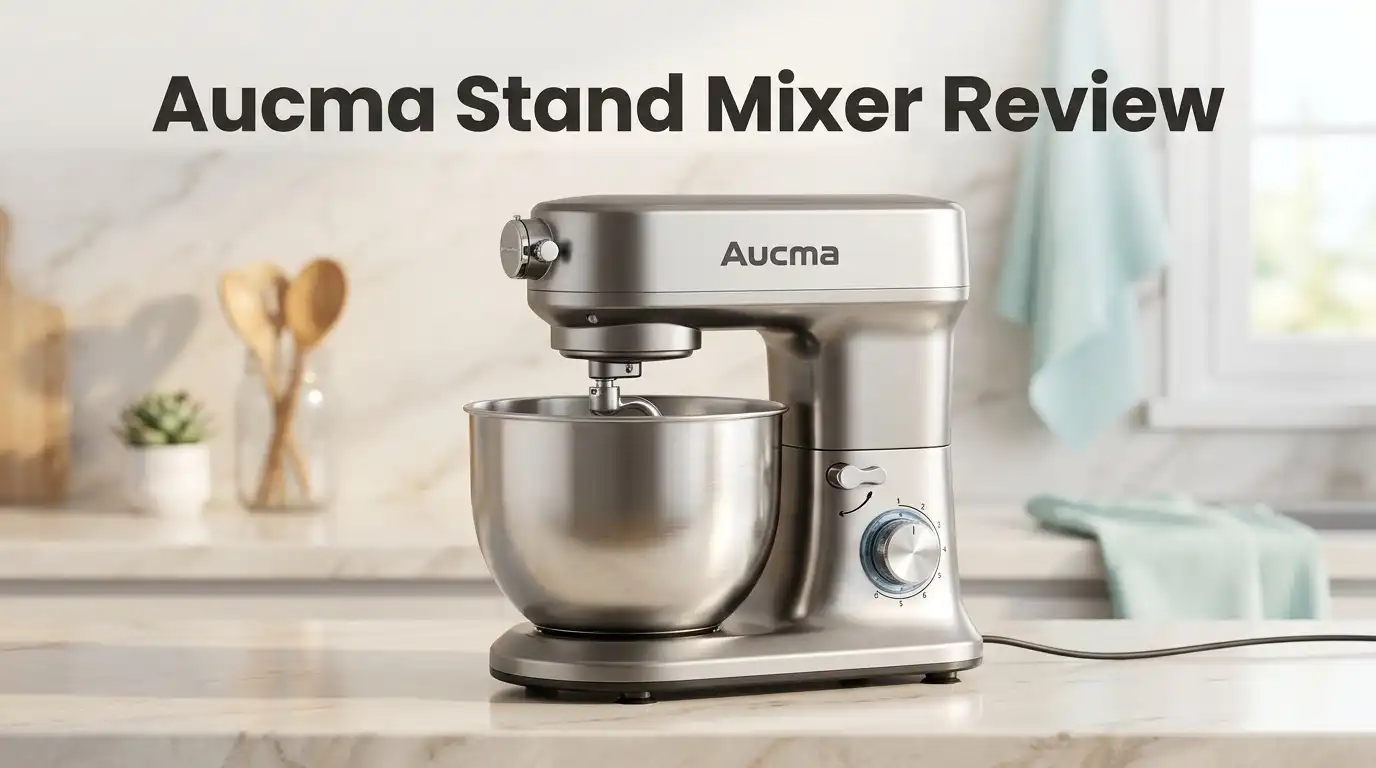
Aucma Stand Mixer Review 2026: Worth Buying?
Baking at home feels fun until your arm gives out halfway through a batch of cookie dough. A stand mixer fixes that problem fast. The trouble is price. A premium mixer can cost more than a month of groceries, and that stings when you only bake on weekends.
The Aucma stand mixer sits at the opposite end of the shelf. It offers a 6.5 quart bowl, a 660 watt motor, and three attachments for a fraction of the money.
Thousands of Amazon buyers have picked it up, and the ratings stay surprisingly high. But cheap kitchen appliances have a habit of disappointing people after month three.
In a Nutshell:
- Big bowl, small price. The 6.5 quart stainless steel bowl holds more than most entry level mixers, and it comes with two side handles for easy lifting. You can double a cookie recipe without splitting the batch.
- The motor is decent, not mighty. The 660 watt copper motor handles cake batter, cookie dough, and soft doughs like focaccia well. Stiff bread dough makes it stutter and warm up, so heavy bread bakers should look elsewhere.
- Whipping is the weak spot. Whipped cream takes over three minutes, and small amounts of cream or egg white sit below the whisk. You will scrape the bowl more often than you expect.
- Build quality feels light but stable. The housing is plastic, yet strong suction feet keep the machine planted on the counter at high speed. The head does bounce during heavy kneading.
- Accessories are generous. You get a whisk, a flat beater, a spiral dough hook, a splash guard, and in many boxes an egg separator. The three main attachments are dishwasher safe.
- Best for casual bakers. This mixer suits beginners, occasional bakers, dorm kitchens, and anyone needing a second machine. Daily bread makers will outgrow it.
Aucma Stand Mixer 6.5 QT: Quick Overview

- Powerful Motor and Variable Speed Control - 660W high performance pure copper motor and sturdy ABS housing; 6 optimized...
- 6.5QT Large Capacity Bowl With Handles - 6.5QT Stainless steel bowl can meet all your kitchen needs. The Stand Mixer is...
Last update on 2026-08-26 / Affiliate links / Images from Amazon Product Advertising API
The Aucma stand mixer is a tilt head machine built around a 6.5 quart stainless steel bowl. The motor draws 660 watts and uses a pure copper winding. The housing is ABS plastic with a painted finish, and you can pick from colors like black, silver, red, blue, and cream.
Speed control sits on a single rotary knob on the right side. You get six speeds plus a pulse setting. Speed one and two suit dry ingredients and dough. Speeds five and six handle cream and egg whites. The pulse position gives short bursts for folding in chocolate chips or nuts.


Last update on 2026-04-08 / Affiliate links / Images from Amazon Product Advertising API
The mixer uses planetary mixing action. The attachment spins on its own axis while it also travels around the bowl. This is the same basic motion premium brands use, and it explains why the Aucma covers the bowl better than a cheap twin beater hand mixer.
Inside the box you get three attachments. The wire whip handles air. The flat beater handles batter and creaming. The spiral dough hook handles bread. All three are dishwasher safe, which saves real time.
The machine weighs around 12 pounds. That is light for a stand mixer. It makes storage easy but also explains the head movement under load. Aucma lists a one year warranty on most listings, though the paperwork inside the box is thin.
Price usually lands well under one hundred dollars during sales. That number is the whole story here.
Unboxing the Aucma Stand Mixer
The box arrives smaller than most people expect. A KitchenAid ships in a heavy carton that feels like furniture. The Aucma box feels closer to a countertop blender. You can carry it inside with one hand.
Open the flaps and you find the mixer body wrapped in a plastic bag, seated inside molded foam. The bowl sits upside down over the head. Attachments hide in a separate cardboard tray on the side. Nothing rattles loose, and the packaging protects the paint well.
The first thing you notice is the finish. The painted body looks glossy and honestly better than the price suggests. Photos do not do it justice. The second thing you notice is the weight, or the lack of it. Lifting the machine out takes almost no effort, which is your first hint about the build.
Setup takes about two minutes. Peel the film, wash the bowl and attachments, and slot the bowl onto the base. The base has three small bumps that line up with grooves in the bowl. This confuses almost everyone on the first try. Turn the bowl slowly until it drops and locks.
The tilt lever sits on the right side. Pull it down and the head pops up. The spring is stronger than expected, so the head jumps a little. Push the head back and it clicks into place.
The manual is short and a bit awkward in its English. It does include speed guidance and a warning that you should not run any attachment longer than three minutes at a time.
Design and Build Quality
The Aucma looks like a premium mixer from three feet away. Get closer and the plastic body becomes obvious. Tap the housing and it sounds hollow. That is the trade you accept at this price.
The bowl is the highlight. Stainless steel, 6.5 quarts, with two horizontal handles like a stock pot. Two handles beat one handle for lifting a full bowl of dough. The handles are thin, but your fingers still fit comfortably.
Four suction cup feet anchor the base. These work well. During high speed mixing the machine stays put instead of walking across the counter. Removing the mixer afterward takes a firm tilt and a small tug, which is a good sign.
The tilt lever operates smoothly most of the time. Pull it only partway and it makes a ratcheting sound that worries new owners. Pull it fully and the motion feels clean.
Two design choices cause daily friction. First, the bowl is wide, so the speed knob sits behind the bowl rim when you stand square in front of the machine. You end up standing slightly to the left. Second, the splash guard must go on before the attachment, which feels backward the first ten times.
Overall the machine feels solid enough for weekly use. It does not feel like a twenty year appliance. Treat it as a five year tool and your expectations will match reality.
Top 3 Alternative for Aucma Stand Mixer

- Built to take it all on with the durable and built-to-last metal construction, and 59 touchpoints around the mixer bowl...
- 4.5 Quart Stainless Steel Bowl to mix up to 8 dozen cookies in a single batch. Dishwasher safe. Using the flat beater...

Last update on 2026-06-09 / Affiliate links / Images from Amazon Product Advertising API
KitchenAid Classic Series 4.5 Quart Tilt Head Stand Mixer

- SUPERIOR FUNCTION: Delivering power, precision and performance, our stand mixer features a 5.5-quart capacity with a...
- MUST-HAVE FEATURES: Polished stainless steel bowl, tilt-back head and one power outlet for optional attachments
Last update on 2026-06-10 / Affiliate links / Images from Amazon Product Advertising API
Cuisinart Precision Master 5.5 Quart Stand Mixer

- SAME MIXING ACTION AS OTHER LEADING BRANDS: Don't pay hundreds of dollars more than you need to for the same mixing...
- THOROUGH MIXING AND COMPLETE BOWL COVERAGE. As you mix, each attachment rotates around the entire bowl as it spins at...
Last update on 2026-08-26 / Affiliate links / Images from Amazon Product Advertising API
Hamilton Beach Electric Stand Mixer 4 Quarts
Motor Power and Speed Control
The 660 watt rating looks big next to a 300 watt Hamilton Beach and even next to a 325 watt KitchenAid Classic. Wattage alone tells you very little. Torque and gearing matter more than the number on the box.
In practice the motor performs well on medium tasks. Cake batter, pancake batter, mashed potatoes, cookie dough, and meatball mixtures all move without complaint. The machine holds its selected speed steadily instead of bogging down.
Stiff dough exposes the limit. During sandwich bread tests the motor audibly stutters. It keeps moving the dough, but the sound changes and the head bounces. After seven minutes of kneading the motor housing feels warm to the touch. That is not a failure, but it is a warning.
The manual asks you to stop after three minutes of continuous running. Three minutes is not enough to develop gluten in most enriched doughs. Many owners ignore this and run longer sessions with rest breaks in between. Short bursts with cooling gaps protect the motor.
Speed control is simple and predictable. The knob clicks through six positions with clear detents. There is no soft start, so speed one still lurches slightly when you switch on. Start low and add flour slowly or you will wear it.
The pulse setting is genuinely useful. Hold the knob at pulse for a second at a time to fold in chips or dried fruit without pulverizing them.
The Bowl and Attachments Explained
Three attachments cover the main jobs. The flat beater creams butter and sugar, mixes batter, and blends anything semi soft. The wire whip adds air to cream and egg whites. The spiral dough hook works bread and pizza dough.
All three snap onto the shaft with a push and twist. The fit is snug and none of them wobble loose during use. The dough hook is the strongest of the three and shows the least flex.
The clearance between attachment and bowl wall is larger than on premium machines. This single fact explains most of the complaints. Ingredients push toward the edge, sit there, and never rejoin the mix. You will stop and scrape the bowl at least once in almost every recipe.
The splash guard is plastic and fits over the bowl rim. It stops flour clouds well. The opening is small and has no funnel lip, so pouring liquid through it takes a steady hand. Getting the guard seated correctly takes patience.
Many boxes include a small egg separator. It is a throwaway extra, but it is a nice touch at this price.
Aucma sells replacement whisks and beaters, though the selection is thin. There is no attachment hub, so you cannot add a pasta roller, meat grinder, or ice cream bowl. That closed system is a real long term limitation compared to KitchenAid.
Bread Dough Performance
Bread is the test that separates real stand mixers from expensive toys. The Aucma passes with conditions attached.
High hydration doughs go well. Focaccia, ciabatta, and wet pizza dough move easily under the spiral hook. The dough climbs, folds, and forms a smooth mass. A five minute session produced a properly developed focaccia with an open, bubbly crumb.
Stiffer dough is harder work. A standard sandwich loaf with low hydration makes the motor labor. The head bounces up and down as the dough ball swings past. The dough passed the windowpane test at seven minutes rather than the usual five. The finished loaf came out slightly lumpy, which points to uneven mixing.
Small batches also cause trouble. Under two cups of flour, the hook cannot catch the dough properly. It smears the mixture around the bottom instead of kneading it.
Practical advice helps a lot here. Add flour gradually rather than dumping it in. Start on speed one. Stop the machine every two or three minutes and let the motor cool. Scrape the bowl bottom once early on.
Weekly bread bakers can live with this machine. Daily bakers, bagel makers, and anyone working with very stiff doughs will frustrate it quickly. For that workload a stronger machine saves money in the long run.
Whipping and Beating Results
Whipping is where the Aucma falls furthest behind. The wire whip does the job, but slowly.
One cup of heavy cream took roughly three and a half minutes to reach stiff peaks. Better mixers finish in under two. The gap grows worse with smaller quantities. Half a cup of cream barely touches the whisk because the bowl is wide and flat at the bottom.
Egg whites behave the same way. A two egg meringue is a struggle. Four or more whites work far better. If your recipes often call for small amounts of whipped ingredients, this machine will annoy you.
Beating is a happier story. Creaming butter and sugar works fine, though you must scrape the bowl twice. A heavy cookie dough loaded with oats, coconut, and nuts distributed evenly and surprised testers with how well the mix ins spread.
Cake batter comes out smooth as long as you scrape once at the halfway point. Frosting mixes well but takes longer to become fluffy.
The pattern is consistent. Tasks that need power and movement go well. Tasks that need air and precise bowl contact go poorly. That trade shapes who should buy this mixer.
If whipped cream and meringue are your main projects, spend more. If cookies, cakes, and batters fill your baking week, the Aucma delivers real value.
Noise Level and Counter Stability
This mixer is loud. Owners say so constantly, and the reports are accurate. At speeds one through three the sound stays reasonable, similar to a food processor. At speeds five and six it becomes a genuine whine that fills the room.
The plastic housing is the reason. Metal bodied mixers absorb and dampen vibration. Plastic amplifies it. You will not hold a conversation next to this machine at full speed.
Kneading adds a second sound layer. The motor pitch drops and the head knocks as the dough swings. That knocking is the head hinge flexing, not a broken part, but it does not inspire confidence.
Stability is much better than the noise suggests. The four suction feet grip smooth countertops firmly. The machine does not travel, even with a heavy dough ball spinning inside. This matters more than it sounds, because a wandering mixer near a counter edge is a real hazard.
Two notes on the feet. They grip laminate and sealed stone best. On textured or unsealed surfaces the suction weakens. Wipe both the feet and the counter before use and the grip improves noticeably.
The mixer weighs about 12 pounds, so lifting it into a cabinet is easy. That same light weight is why the suction cups matter so much. Take them away and the machine would slide.
Expect noise. Plan around it if you bake early in the morning near sleeping family members.
Cleaning and Everyday Maintenance
Cleanup is straightforward. The three attachments and the stainless bowl are dishwasher safe according to Aucma. Most owners still hand wash the whisk because dried batter hides between the wires.
The bowl wipes clean in seconds. Stainless steel resists staining, though tomato based mixtures can leave a faint tint that vinegar removes. Never use steel wool on the bowl or you will scratch the finish.
The body needs a damp cloth only. Never submerge it. The painted surface shows fingerprints and flour dust, so keep a microfiber cloth nearby if you like a clean look.
Two spots collect mess. The first is the shaft where attachments mount. Batter creeps up during high speed mixing and dries into a crust. Wipe it after every use. The second is the seam where the head meets the body. A dry brush clears flour from that gap.
The splash guard is the least pleasant part to clean. Its shape traps batter in the rim channel and it does not always fit dishwasher racks well. Hand washing takes about a minute.
Maintenance is otherwise minimal. There are no user serviceable gears and no lubrication points. This is a sealed appliance, so a gear failure usually means replacement rather than repair. Keep your purchase receipt and register the warranty if the option appears.
Store the mixer with the head locked down. That reduces stress on the hinge spring over time.
What the Aucma Stand Mixer Does Not Do Well
Honest reviews list failures. Here are the real ones.
Whipping small quantities is genuinely poor. Anything under one cup of cream or three egg whites sits below the whisk path. You will finish the job with a hand whisk.
The three minute run limit is restrictive. Serious bread doughs need longer kneading. Following the manual makes proper gluten development difficult. Ignoring it risks motor heat.
Bowl coverage is incomplete. The gap between attachment and bowl wall forces manual scraping in most recipes. Premium mixers reduce this problem with tighter tolerances.
There is no attachment ecosystem. No pasta roller, no grinder, no spiralizer. What comes in the box is what you get forever.
Warranty support is inconsistent. Some owners report smooth replacements. Others cannot find clear warranty documentation at all. Buy through a retailer with a strong return policy.
The head flexes under load. Watching it bounce during kneading raises fair questions about lifespan. Reports of failure after two to three years of heavy use exist.
Noise is above average. The plastic body offers little sound damping at high speeds.
The splash guard design frustrates. Small opening, no funnel, awkward installation order.
None of these are deal breakers for a casual baker. Together they explain why the price is what it is. You are buying capability, not refinement.
Pros and Cons
Here is the balanced view in list form.
Pros
- Large 6.5 quart bowl holds double batches and comes with two comfortable side handles for lifting.
- Strong value for money with a price that often sits below one hundred dollars during sales.
- Planetary mixing action covers more of the bowl than any hand mixer can manage.
- Excellent counter grip thanks to four suction cup feet that stop the machine from moving at speed.
- Complete starter accessory set including whisk, flat beater, spiral dough hook, splash guard, and often an egg separator.
- Light and easy to store, since the machine weighs only about 12 pounds.
- Dishwasher safe attachments cut cleanup time after big baking sessions.
- Attractive color choices that look far more expensive than they are.
Cons
- Slow whipping performance, with whipped cream taking over three minutes to reach stiff peaks.
- Struggles with stiff bread dough, showing motor stutter and noticeable head bounce.
- Three minute continuous run limit that restricts longer kneading sessions.
- Frequent bowl scraping needed because of the wide gap between attachment and bowl wall.
- Loud operation at higher speeds due to the plastic housing.
- No optional attachments available, so the mixer cannot expand its abilities later.
- Unclear warranty support with thin documentation in the box.
- Awkward splash guard with a small opening and no pour funnel.
Aucma vs KitchenAid Classic Series: Which One Fits You?
- Powerful Motor and Variable Speed Control - 660W high performance pure copper motor and sturdy ABS housing; 6 optimized...
- 6.5QT Large Capacity Bowl With Handles - 6.5QT Stainless steel bowl can meet all your kitchen needs. The Stand Mixer is...
Last update on 2026-08-26 / Affiliate links / Images from Amazon Product Advertising API
These two machines target different buyers, even though shoppers compare them constantly.
The KitchenAid Classic Series uses a metal body, a 4.5 quart bowl, and 10 speeds. It costs roughly three to four times more. It whips faster, mixes more evenly, and runs quieter. It also accepts dozens of hub attachments, which turns it into a grinder, pasta maker, or ice cream churn.
The Aucma counters with a bigger bowl and a much smaller price. If you bake large batches for a family, that extra two quarts matters on cookie day. The Aucma also matches the KitchenAid closely on cookie dough and cake batter, which covers most home baking.
Durability is the honest divide. KitchenAid machines routinely last fifteen years and can be repaired. The Aucma is a sealed plastic appliance with a realistic lifespan of three to six years under moderate use.
Think about cost per year rather than sticker price. Bake twice a month and the Aucma is the smarter purchase. Bake twice a week with bread in the rotation and the KitchenAid becomes cheaper over time.
Choose the Aucma if you want capacity now at low cost. Choose the KitchenAid if you want a machine that outlives your kitchen renovation. Both answers are correct depending on your habits.
Who Should Buy the Aucma Stand Mixer?
This mixer fits specific people extremely well and disappoints others.
Buy it if you are a beginner baker. You get real stand mixer function without a painful investment. If baking becomes a passion, you upgrade later with knowledge you did not have before.
Buy it if you bake occasionally. Holiday cookies, birthday cakes, weekend pancakes, and the odd pizza dough all fall inside this machine’s comfort zone.
Buy it if you need capacity on a budget. The 6.5 quart bowl beats most similarly priced options and even beats several expensive ones.
Buy it as a second mixer. Plenty of owners keep it for frosting and light batter while their main machine handles bread.
Skip it if you bake bread weekly. The run time limit and motor strain will frustrate you.
Skip it if you whip a lot of cream or meringue. Slow whipping and poor small batch contact are structural problems, not user error.
Skip it if you want attachments. No hub means no expansion.
The verdict is simple. The Aucma stand mixer delivers roughly eighty percent of the everyday function of a premium machine for about a quarter of the price. The missing twenty percent is refinement, whipping speed, and lifespan. For a large group of home bakers, that trade is a clear win.
Frequently Asked Questions
Is the Aucma stand mixer good for bread dough?
It handles soft and high hydration doughs well, including focaccia and pizza dough. Stiff sandwich bread dough makes the motor stutter and the head bounce. Knead in short sessions with rest breaks and keep batches at two to six cups of flour for best results.
How many watts is the Aucma stand mixer?
The standard 6.5 quart model uses a 660 watt pure copper motor. Aucma also sells an 8 quart version rated at 900 watts. Remember that wattage measures power draw rather than actual mixing torque.
Are the Aucma attachments dishwasher safe?
Yes. The whisk, flat beater, and dough hook are all listed as dishwasher safe, along with the stainless steel bowl. The motor housing must never be submerged and should only be wiped with a damp cloth.
Can you use KitchenAid attachments on an Aucma mixer?
No. The Aucma uses its own shaft design and has no front attachment hub. Only Aucma replacement parts fit, and the selection is limited to basic accessories.
How long does the Aucma stand mixer last?
Most owners report three to six years of reliable use with moderate baking. Heavy weekly bread making shortens that considerably. The sealed plastic housing makes repair impractical, so replacement is the usual outcome.
Is the Aucma stand mixer loud?
Yes, it is louder than metal bodied mixers. Low speeds stay manageable, but speeds five and six produce a noticeable whine. The plastic housing offers little sound damping.
Does the Aucma stand mixer come with a warranty?
Most listings mention a one year warranty. Documentation inside the box is thin and support experiences vary. Buying from a retailer with a solid return window is the safer route.

Hi, I’m Liza Jensen, your culinary companion here at Recipe by Liza. 🍳🥗Cooking has always been my passion—I find joy in every whisk, every sizzle, and every aromatic spice. As a home cook and recipe developer, I’ve explored flavors from around the world, creating dishes that warm hearts and tantalize taste buds.Join me on this flavorful journey! Let’s swap kitchen stories, share tips, and celebrate the magic of food together.