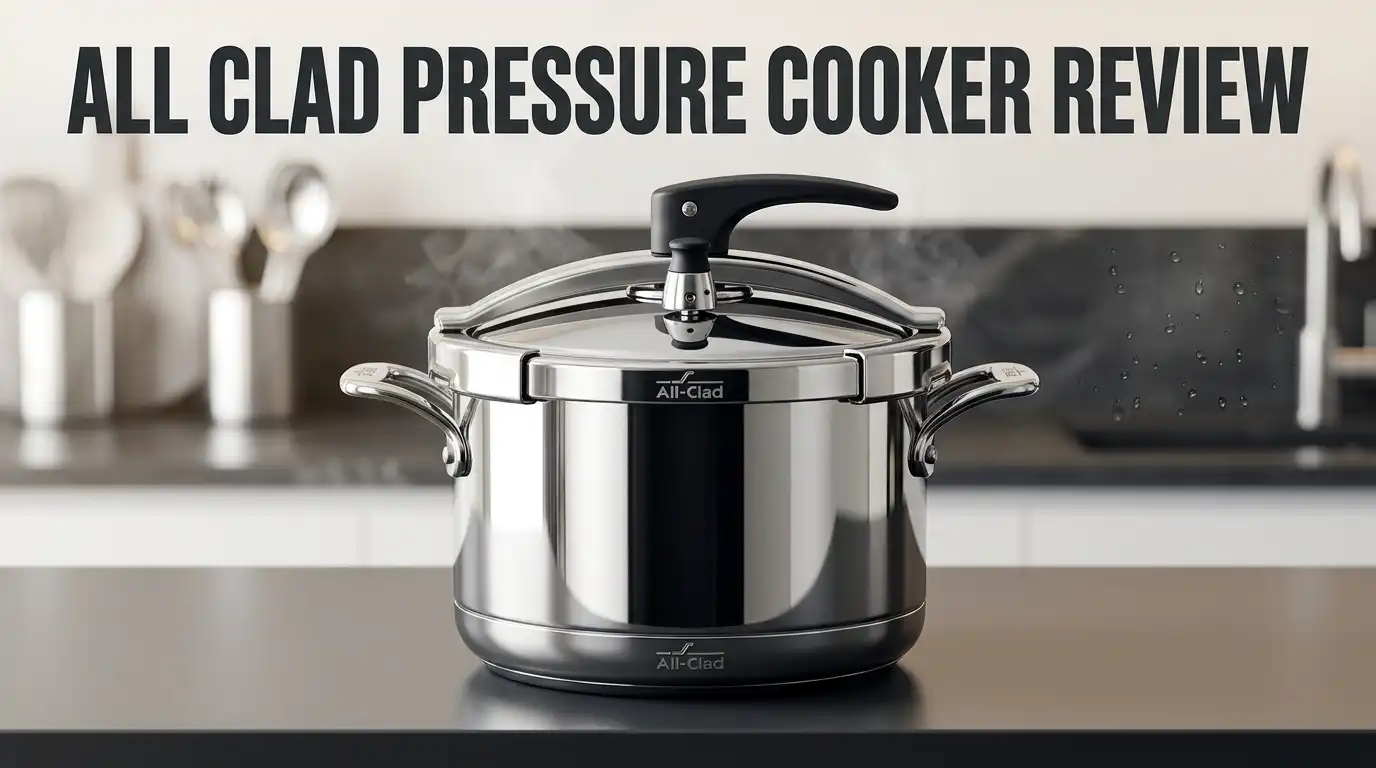
All Clad Pressure Cooker Review 2026: Still Worth It?
All Clad built its name on heavy stainless steel pans that outlive their owners. So a pressure cooker from the same brand raises an obvious question. Does that reputation carry over to a sealed pot that runs at 10 psi?
I spent weeks cooking stocks, short ribs, beans and rice in the All Clad 8.4 quart pressure cooker. I also compared it against the electric multicookers that dominate kitchen counters in 2026.
This review covers the good, the frustrating and the parts nobody mentions in the product photos. You will get honest answers before you spend a few hundred dollars.
In a Nutshell:
- It is a stovetop cooker with an electronic brain. The 8.4 quart pot sits on your burner, but a removable digital timer clips onto the lid and beeps when pressure and time targets are reached. That hybrid setup is unusual, and it splits opinion sharply.
- The pot itself is genuinely excellent. You get 18/10 stainless steel, a thick encapsulated aluminum base, a 10 inch cooking surface and oven safety up to 600F. This is real All Clad hardware, not a rebadged import.
- Searing beats every electric pressure cooker. Direct burner heat browns meat properly. Electric models like the Instant Pot cannot match that Maillard crust, and this remains the single strongest argument for buying it.
- The instructions confuse many owners. Reddit threads and Amazon reviews repeatedly mention unclear manuals, preset programs instead of plain psi settings, and a learning curve that lasts several meals.
- Amazon stock is unreliable in 2026. The listing frequently shows as unavailable, and the average rating sits around 4.0 stars from a small review pool. Prices swing between roughly $140 and $400 depending on the seller.
- Buy it for searing and durability, skip it for convenience. If you want set and forget weeknight dinners, an electric multicooker serves you better for a third of the money.
All Clad Specialty Stainless Steel Pressure Cooker 8.4 Quart

- Features deep dimensions and unparalleled versatility
- Base is made from stainless steel for solid durability and even heat distribution
Last update on 2026-08-18 / Affiliate links / Images from Amazon Product Advertising API
This is the model most people mean when they search for an All Clad pressure cooker. The official capacity is 8.4 quarts, or about 7.95 liters.
The body measures roughly 15 inches wide by 10 inches deep by 12 inches tall. It weighs a little over 10 pounds empty, which tells you plenty about the metal thickness.


Last update on 2026-04-08 / Affiliate links / Images from Amazon Product Advertising API
The base is the star here. A thick aluminum core sits sandwiched inside stainless steel, giving you a 10 inch searing surface that heats evenly across the whole disc.
It works on gas, electric, ceramic and induction burners. That flexibility matters if you move house or switch cooktops.
The lid carries a removable smart timer with four optimized programs: vegetables, grains, meat and poultry, and seafood. The timer sounds alerts when the pot reaches pressure and again when cooking finishes.
All Clad rates the pot as oven and broiler safe to 600F once the lid is off. You can brown a chuck roast, pressure cook it, then finish it under the broiler in the same vessel.
The set includes a steaming basket and a recipe booklet with more than 40 recipes. Five separate safety features guard against overpressure and accidental opening.
Everything except the timer, control panel and gasket goes in the dishwasher. That is a meaningful convenience for a pot this size.
Unboxing Experience and First Impressions
The box arrives heavier than expected. Mine weighed close to 15 pounds with packaging, and the cardboard barely flexed when I lifted it.
Inside, the pot sits nested in molded protection with the lid inverted on top. The steaming basket hides underneath the pot, along with the recipe booklet and manual.
First impression: this thing is polished like jewelry. The mirror finish on the exterior reflects your kitchen back at you, and the riveted side handles feel solid enough to swing a toddler from.
The handles deserve a mention. They are wide loop handles, not a long stick handle, so you can grip the pot with thick oven mitts on both hands.
Lifting a full 8.4 quart pot of stock requires that kind of grip.
Peeling the protective film off the timer module felt like unwrapping a phone. The little digital unit clips onto the lid with a satisfying click.
The gasket comes preinstalled, which saves guesswork. I ran a quick water test before cooking anything, and the pot reached pressure in about nine minutes on a medium gas burner.
The manual is where the shine fades. It reads like a translated technical document, and the preset logic is not explained in plain language.
I had to read the pressure section three times before I understood that the cooker does not let you dial a specific psi. That was my first hint that this is a quirky product.
Build Quality and Everyday Feel
Pick this pot up and you understand the price. The wall thickness feels closer to a stockpot than a typical pressure cooker.
The aluminum core does exactly what All Clad promises. Beans on the bottom do not scorch while the top of the pot sits cool, because heat spreads sideways instead of concentrating over the flame.
The lid locks with a rotating action. You line up the arrows, twist and hear a firm mechanical stop.
Compared to Kuhn Rikon or Fissler, the closing motion feels slightly stiffer. It loosens after a dozen uses as the gasket beds in.
The stainless interior does show cooking marks over time. Tomato sauces leave faint discoloration, and browning at high heat can create rainbow tinting on the walls.
None of that affects performance. Bar Keepers Friend removes it in about two minutes if the look bothers you.
Several owners report scratches appearing quickly on the polished exterior. Metal utensils and crowded dish racks are the usual cause.
The riveted handles have held up in my testing with no wobble. Rivets are a good sign in cookware because they outlast spot welds by decades.
One honest gripe: the pot is tall and wide, so it eats an entire cabinet shelf. Storage is a real consideration in a small kitchen.
This is a lifetime pot in a category where most cookers get replaced every five years.
Top 3 Alternative for All Clad Pressure Cooker

- 9 Cooking Functions: Pressure cook, slow cook, sauté, sous vide, steam, sterilize, keep warm, make rice and...
- Customizable Smart Programs: Tackle every recipe with 15 one-touch options, from hearty soups to decadent cakes

Last update on 2026-06-09 / Affiliate links / Images from Amazon Product Advertising API
Instant Pot Duo Plus 9 in 1 Electric Pressure Cooker, 6 Quart

- The Breville Fast Slow Pro pressure cooker automatically adjusts time, temperature and pressure between fast and slow...
- MULTI FUNCTION COOKING: One-press functionality employs dual sensors at the top and bottom of the 6 qt bowl to monitor...
Last update on 2026-08-18 / Affiliate links / Images from Amazon Product Advertising API
Breville Fast Slow Pro Pressure Cooker BPR700BSS, 6 Quart

- Dinner in Half the Time: Cook up to 2x faster* with our Secure 6.3 quart pressure cooker, perfect for all your favorite...
- Designed With Your Safety In Mind: the Secure pressure cooker features a 5-point security system. Its intuitive rotating...
Last update on 2026-06-09 / Affiliate links / Images from Amazon Product Advertising API
T Fal Secure Stainless Steel Stovetop Pressure Cooker, 6.3 Quart
The Removable Smart Timer Explained
The timer is the most divisive feature on this cooker. It is a small battery powered module that snaps onto the lid.
The concept sounds clever. You choose a food category, the sensor detects when pressure builds, and the countdown starts automatically.
In practice, the interface hides information you actually want. There is no display showing psi, and no way to set 12 psi versus 15 psi.
You get four programs and a time adjustment. That is the whole system.
For traditional recipes, this creates friction. A classic cookbook tells you to cook stock at 15 psi for 45 minutes, and this cooker simply does not speak that language.
The workaround is simple once you accept it. Pick the closest program, set your time manually and treat the presets as heat guidance rather than rules.
The audible alerts genuinely help. A chirp when pressure is reached means you can lower the burner immediately instead of hovering over the stove.
You must remove the timer before washing the lid. Forgetting this ruins the electronics, and the warranty will not cover it.
Battery life ran several months in my testing with regular use. Replacements are standard coin cells.
Some long term owners report timer failures after a few years. When the electronics die, you can still use the pot as a manual pressure cooker, which softens the blow.
Cooking Performance in a Real Kitchen
Performance is where this cooker earns forgiveness for its quirks. Food comes out excellent.
Beef stock reached a deep amber color in 45 minutes. The same result takes six hours in an open stockpot.
Dried chickpeas cooked from raw in 35 minutes with no soaking, and they held their shape instead of turning to mush.
Short ribs braised in 40 minutes came out fork tender with a sauce that had actual body. The wide base let me brown all the ribs in two batches instead of four.
Rice works, though the grains program runs slightly aggressive. I shave two minutes off the suggested time for basmati.
Vegetables are the weak spot. The pot requires around three cups of water for steaming, which is a lot of thermal mass to heat and then cool.
Broccoli overcooks easily because pressure takes too long to release. Fast steaming demands a small water volume, and this design does not allow it.
Pressure release is manual through the valve. Quick release throws a strong jet of steam, so keep your hand clear and angle the valve away from cabinets.
Time to pressure averaged eight to eleven minutes on a standard gas burner with a full pot. That is normal for a stovetop unit and roughly twice as fast as most electrics.
Searing, Browning and the Four Preset Programs
Searing is the reason to choose stovetop over electric. Nothing else comes close.
I dropped a chuck roast into the preheated pot with a spoon of oil. Within four minutes I had a genuine brown crust with fond stuck to the base.
An Instant Pot cannot do this. Its saute function tops out around a simmer, and Serious Eats testing repeatedly notes that food sticks and steams instead of browning.
Deglazing with wine lifted every bit of fond. That flavor ends up in the finished braise, and you taste the difference.
The four programs each set a target pressure and a suggested time. Meat and poultry runs highest, seafood runs lowest.
Think of them as coarse presets, not precision tools. You can override the time on any of them.
The grains program suits rice, farro and barley. The vegetables program suits potatoes and root vegetables better than delicate greens.
The seafood program handles octopus and shellfish stock nicely. Fish fillets cook too fast for pressure to be useful.
Sear first, then pressure cook, then reduce. That three step workflow uses one pot and produces restaurant quality results.
The 10 inch base means you can brown four large pieces at once. Narrower pressure cookers force you into more batches, which wastes time and dries out the meat.
Safety Features Worth Knowing
All Clad builds five safety mechanisms into this design. Understanding them makes the cooker far less intimidating.
The primary pressure regulator vents steam once the target pressure is reached. This is normal operation, not a fault.
A secondary safety valve opens if the primary blocks. Food debris occasionally clogs valves, and this backup prevents a dangerous buildup.
The lid physically cannot open while pressure remains inside. A locking pin engages as pressure rises and drops only when the interior returns to atmospheric level.
A gasket expansion window releases steam sideways in an extreme overpressure event. You will likely never see it activate.
The handle alignment system prevents partial locking. If the lid is not fully seated, the cooker simply will not build pressure.
Practical safety habits still matter. Never fill past the two thirds line, and never past the halfway line with foamy foods like beans, lentils or pasta.
Clean the valve after every use. A quick rinse and a look through the hole takes ten seconds.
Replace the gasket every twelve to eighteen months with regular use. A hardened gasket is the most common cause of pressure loss.
Modern pressure cookers are far safer than the exploding pots of the 1970s. This one meets current standards comfortably.
If the pot fails to reach pressure, the culprit is almost always the gasket, the valve or an unseated lid.
All Clad Stainless Steel Pressure Cooker With Steaming Basket
- Features deep dimensions and unparalleled versatility
- Base is made from stainless steel for solid durability and even heat distribution
Last update on 2026-08-18 / Affiliate links / Images from Amazon Product Advertising API
The included steaming basket is easy to overlook, yet it changes how you use the pot day to day.
The basket sits above the water line on short legs. Food steams under pressure rather than boiling in liquid.
Potatoes for mash cook in about eight minutes and stay dry enough to fluff properly. Boiling waterlogs them by comparison.
Beets, carrots and winter squash all work well. Dense vegetables benefit most because pressure steaming cuts their cook time by two thirds.
The three cup water requirement remains the main limitation. Delicate vegetables lose their texture before the pot depressurizes.
I use the basket for meal prep more than for side dishes. A full basket of chickpeas or potatoes for the week takes minutes.
The basket also elevates jars for small batch pickling and holds tamales upright. It is stainless steel and dishwasher safe.
Storage inside the pot keeps it from wandering. Mine lives nested under the lid.
Buy this cooker for the base and the basket, not for the timer. The mechanical parts are where All Clad quality shows up most clearly.
Availability on Amazon fluctuates through 2026, so check the current listing status and seller rating carefully before ordering. Prices from third party sellers vary widely for identical stock.
What This Pressure Cooker Does Not Do Well
Honest reviews name the weaknesses. This cooker has several.
The manual is poorly written. Multiple owners across forums describe the instructions as unclear, and I agree completely.
You cannot select a specific psi. Anyone following classic pressure cooking recipes will find this genuinely annoying.
The cooker vents during operation rather than holding a fully sealed environment. Some cooking enthusiasts argue this keeps liquid at a rolling boil, which is not ideal for clear stocks.
Steaming needs too much water. Fast, precise vegetable steaming is not achievable here.
The timer electronics are a failure point. Reports of dead units after a few years appear regularly, and warranty service draws complaints.
It is expensive. You can buy three Instant Pots for the price of one of these, and the Instant Pot will handle slow cooking, yogurt and rice too.
It does not slow cook, saute electrically, make yogurt or hold food warm. This is a single purpose pressure cooker.
The polished exterior scratches. Owners in cooking groups mention visible marks appearing early.
It needs babysitting. Stovetop cookers require you to adjust the burner as pressure builds, unlike an electric that manages itself.
Storage is bulky. An 8.4 quart pot with a domed lid claims serious cabinet real estate.
Finally, stock availability is spotty, and that alone frustrates buyers.
Pros and Cons of the All Clad Pressure Cooker
Here is the honest balance sheet after extended testing.
Pros
- Outstanding searing performance thanks to direct burner heat and a 10 inch aluminum core base that browns meat properly before pressure cooking begins.
- Exceptional build quality with 18/10 stainless steel, riveted handles and oven safety to 600F, giving you a pot that should last decades rather than years.
- Fast time to pressure at roughly eight to eleven minutes, which is about half what most electric multicookers need for the same volume.
- Generous 8.4 quart capacity that suits stock making, large braises and batch cooking for families or meal prep enthusiasts.
- Works on every cooktop including induction, plus the pot, lid and basket clean up in the dishwasher once the electronics come off.
- Five safety mechanisms and an included steaming basket, recipe booklet and audible pressure alerts add real practical value.
Cons
- No direct psi control, only four preset food programs, which frustrates anyone cooking from traditional pressure cooking recipes.
- Confusing manual that leaves new owners guessing about basic operation for the first several meals.
- Timer electronics can fail, and warranty support receives frequent criticism from owners who have needed it.
- Requires three cups of water for steaming, making quick, crisp vegetable results essentially impossible.
- Premium price for a single function tool while electric multicookers deliver nine functions for far less money.
- Requires attention during cooking because you must manage burner heat manually rather than pressing a button and walking away.
- Inconsistent Amazon availability in 2026, with wide price swings between sellers.
Cleaning, Care and Long Term Ownership
Cleaning is straightforward if you follow one rule. Remove the timer, control panel and gasket before anything touches water.
The pot itself handles the dishwasher without complaint. I still hand wash mine because it takes two minutes and keeps the polish nicer.
Stainless steel discolors, and that is chemistry, not damage. Heat tinting shows up as faint blue or rainbow patches on the interior walls.
A stainless cleaner removes it fully. White vinegar handles mineral deposits from hard water.
The gasket needs the most attention. Rinse it after every use, dry it fully and store it loose rather than stretched over the lid.
A stretched gasket leaks, and a leaking cooker never reaches pressure. Replacement gaskets are inexpensive and worth keeping on hand.
Check the valve opening before every session. Hold the lid up to a light and look straight through the hole.
Never store the lid locked onto the pot. Trapped moisture creates odors and compresses the gasket.
The exterior polish scratches easily, so avoid abrasive pads on the outside. Use a soft cloth and cream cleaner instead.
Long term ownership is genuinely realistic here. One owner in a cooking forum reported ten years of regular use with no issues.
The electronics are the weak link, but the pot survives their death. You still own a first class pressure cooker without the timer attached.
All Clad vs Instant Pot vs Breville
These three represent completely different philosophies. Choosing well means matching the tool to how you actually cook.
The All Clad is a chef tool. It sears beautifully, reaches pressure fast and lasts forever, but it demands your attention and offers no other functions.
The Instant Pot Duo Plus is a convenience machine. Nine functions, a low price, huge recipe community support and total hands off operation.
Its weakness is searing. The saute function never gets hot enough for a proper crust, and food sticks to the inner pot.
The Breville Fast Slow Pro sits between them. It offers adjustable pressure in small increments, automatic steam release and a display that actually tells you what is happening.
Food and Wine testing has repeatedly named the Breville a favorite for its control and ease of use. It costs roughly the same as the All Clad.
Speed comparison: the All Clad reaches pressure fastest, the Breville second, the Instant Pot slowest.
Flavor comparison: the All Clad wins on browning, and that advantage carries through to the finished dish.
Convenience comparison: the Instant Pot wins easily, followed by the Breville.
Longevity comparison: the All Clad wins by a wide margin because the pot is simple metal.
My honest recommendation splits by kitchen personality. Serious cooks who already own good stainless cookware will appreciate the All Clad, while busy households get more daily value from an electric.
Price, Availability and Value in 2026
Pricing on this cooker is genuinely confusing. That is worth flagging before you buy.
Specialty cookware retailers have listed the 8.4 quart model around $140 to $150 on sale. Regular pricing sits closer to $200.
Third party sellers have listed the same model above $400. That is not a fair price, and you should walk away from those listings.
The Amazon listing for the stovetop model frequently shows as unavailable in 2026. All Clad appears to have deprioritized this product line.
The average rating sits at 4.0 stars from a modest review pool of around 74 buyers. That is a decent but not outstanding score.
Compare that to the Instant Pot Duo Plus at under $100 with tens of thousands of reviews. Value depends entirely on what you want.
For $150, this cooker is a strong buy. The metal alone justifies the money.
For $400, it makes no sense. The Breville Fast Slow Pro costs less and does more.
Check outlet retailers and warehouse clubs. One buyer found a new boxed unit for $100 on a marketplace, which is exceptional value.
Set a price ceiling before you shop. I would pay up to $200 happily, and no more than $250 under any circumstance.
Watch for holiday sales in November and around Mother’s Day, when All Clad discounts run deepest.
Who Should Buy It and Who Should Skip It
Clarity here saves you money and disappointment.
Buy this cooker if you make stock regularly. The capacity, the speed and the ability to brown bones first make it outstanding for that job.
Buy it if you already cook on a stovetop and enjoy hands on control. The learning curve rewards people who like adjusting a flame.
Buy it if you value cookware that outlives you. This pot will still work in 2050 with a fresh gasket.
Buy it if searing matters to your cooking. No electric multicooker browns meat properly, and that gap is not closing.
Skip it if you want a set and forget appliance. You will resent the burner management within a month.
Skip it if you cook mostly rice, yogurt or slow cooked meals. A multicooker handles all of that in one machine.
Skip it if you need precise psi control for canning or traditional recipes. The preset system will fight you.
Skip it if the current price exceeds $250. Better options exist at that level.
Skip it if crisp steamed vegetables are a priority. The water requirement makes that goal unreachable.
The ideal owner is an experienced home cook who already loves stainless cookware. That person will use this pot weekly for twenty years and consider it money well spent.
Everyone else should buy an Instant Pot and spend the difference on good ingredients.
Frequently Asked Questions
Is the All Clad pressure cooker electric or stovetop?
The 8.4 quart model is a stovetop pressure cooker with an electronic timer attached to the lid. You heat it on your burner. All Clad also produced a fully electric 6 quart model in the past, but it is discontinued and hard to find new.
What pressure does the All Clad pressure cooker reach?
It operates around 10 psi to 12 psi depending on the selected program. The display does not show a psi number, which is the most common complaint from experienced pressure cooker users.
Can you use the All Clad pressure cooker on induction?
Yes. The encapsulated stainless steel base is fully induction compatible, and it also works on gas, electric coil and ceramic cooktops.
Is the All Clad pressure cooker dishwasher safe?
The pot, lid and steaming basket are dishwasher safe once you remove the timer, control panel and gasket. Washing the electronics will destroy them and void your warranty.
Why is my All Clad pressure cooker not building pressure?
Check three things in order. First, confirm the lid is fully locked with the arrows aligned. Second, inspect the gasket for cracks, stretching or debris. Third, hold the lid up to a light and make sure the valve hole is clear.
How long do you cook stock in the All Clad pressure cooker?
Use the meat and poultry program for 45 to 60 minutes. Brown the bones in the pot first for a much deeper flavor, then add water and lock the lid.
Is the All Clad pressure cooker better than an Instant Pot?
It sears better, reaches pressure faster and lasts longer. The Instant Pot is cheaper, offers nine functions and requires no attention while cooking. Choose based on whether browning or convenience matters more to you.
Does All Clad still make pressure cookers in 2026?
The stovetop model remains in the catalog, but availability is inconsistent and the listing often shows as out of stock. Specialty cookware retailers are usually the more reliable source.
How much should I pay for an All Clad pressure cooker?
Fair value sits between $140 and $200. Listings above $300 are overpriced, and better performing alternatives exist at that level.
Can I use the All Clad pressure cooker for canning?
It is not recommended for pressure canning. Canning requires verified pressure levels held precisely, and this cooker does not display psi. Use a dedicated pressure canner instead.

Hi, I’m Liza Jensen, your culinary companion here at Recipe by Liza. 🍳🥗Cooking has always been my passion—I find joy in every whisk, every sizzle, and every aromatic spice. As a home cook and recipe developer, I’ve explored flavors from around the world, creating dishes that warm hearts and tantalize taste buds.Join me on this flavorful journey! Let’s swap kitchen stories, share tips, and celebrate the magic of food together.