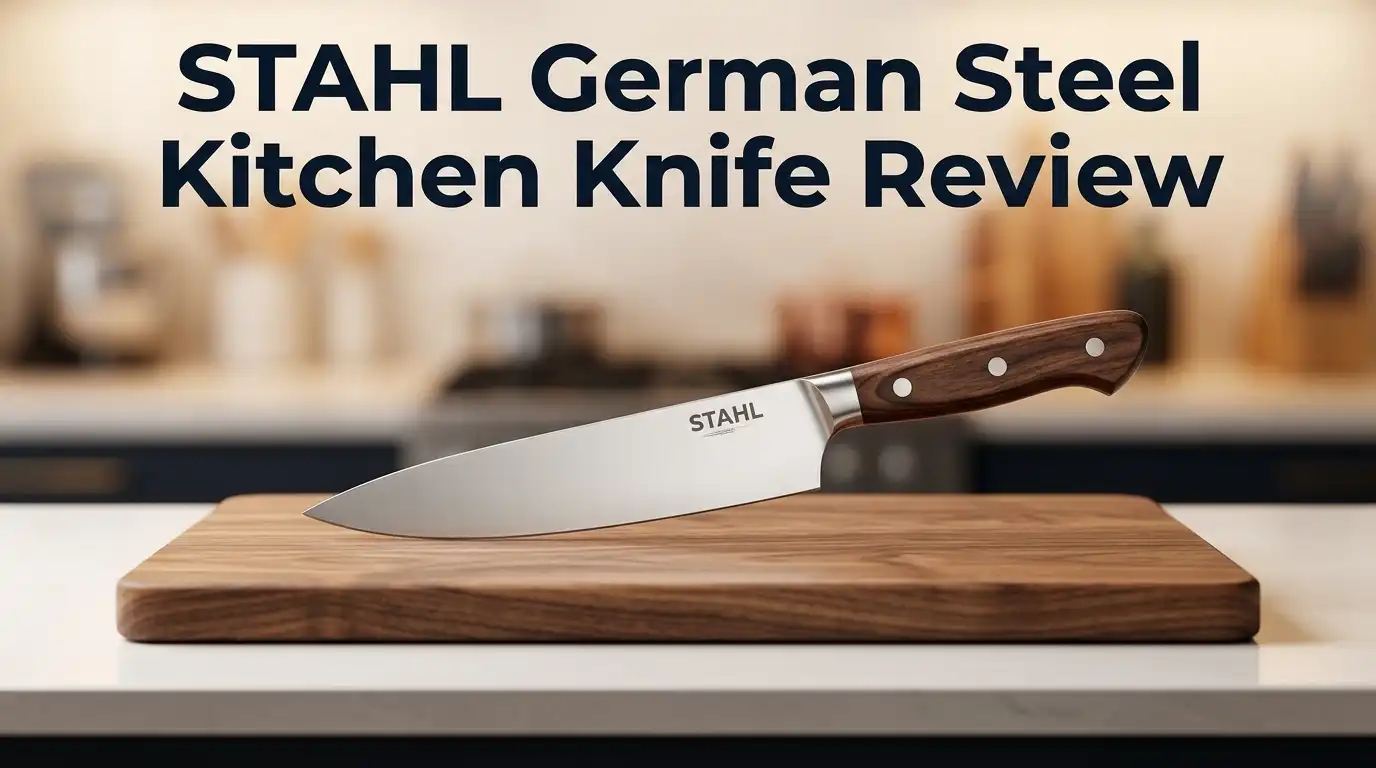
Stahl German Steel Kitchen Knife Review 2026: Worth Buying?
Sharp knives change how you cook. A dull blade makes you push, slip, and rush. A sharp blade lets you glide through an onion in seconds.
The Stahl line from Klaus Meyer promises German steel performance at a price that will not hurt your wallet. That claim gets thrown around a lot in 2026. Every brand on Amazon says “German steel” now.
So I spent weeks chopping, slicing, carving, and washing this knife to find out what holds up and what does not. This review covers the unboxing, the steel spec, the sharpness, the weak points, and the honest verdict.
In A Nutshell:
- The steel is legitimate. Stahl blades use X50CrMov15, also called 1.4116, the same alloy family found in Wusthof and Henckels kitchen knives. It sits at 54 to 56 HRC hardness, which trades a little edge retention for easy sharpening and high toughness.
- The edge angle is friendly. Stahl grinds the edge at 15 to 17 degrees per side. That is sharper than older German knives at 20 degrees, so food release feels cleaner and slicing feels lighter.
- The build is real forged style. You get a full tang, a curved heavy bolster, a triple rivet ABS handle, and a solid endcap. Balance lands close to the bolster, which most home cooks prefer.
- The value is the main selling point. A single Stahl chef knife costs roughly what one premium German knife costs in tax. Sets stretch that value further.
- It is not a Japanese slicer. Edge retention is average. You will touch up the edge more often than a hard steel blade at 60 HRC. The ABS handle feels plain next to pakkawood.
- Best fit: home cooks, new cooks, rental kitchens, gift buyers, and anyone building a first real knife drawer.
What Is The Stahl German Steel Kitchen Knife?

- Superior Forged Quality from X50CrMov15 (1.4116) Exclusive High Carbon Steel Forging from our secret recipe of superior...
- Full Tang with Solid Curved Heavy Bolster for Amazing Grip and Balance A full tang design, where the blade extends into...
Last update on 2026-08-19 / Affiliate links / Images from Amazon Product Advertising API
Stahl is the classic series from Klaus Meyer. The word Stahl simply means steel in German, and the naming fits the product.
The line covers a full kitchen lineup. You get an 8 inch chef knife, a santoku, a serrated bread knife, a carving knife, a utility knife, and a paring knife. Block sets run from 3 pieces up to 19 pieces.


Last update on 2026-04-08 / Affiliate links / Images from Amazon Product Advertising API
Every Stahl blade uses the same core recipe. High carbon X50CrMov15 German steel, oil quenched, full tang, triple riveted handle. The finish is plain and clean with no hammered dimples or fake damascus patterns.
This is a working knife, not a display knife. Klaus Meyer aims the Stahl series at home cooks who want forged style performance without a three figure price tag.
The chef knife carries a 2.2mm blade spine. That is thinner than a heavy German workhorse and thicker than a Japanese gyuto. The middle ground works well for mixed prep.
Handle material is ABS plastic rather than wood or micarta. ABS resists stains, water, and heat. It also feels less premium in the hand, and I will come back to that.
Colors come in black and white. The white version looks bright in a modern kitchen but shows scuffs faster around the rivets.
Unboxing The Stahl Chef Knife
The box arrived slim and light. No frills, no magnetic flap, no ribbon.
Inside I found a printed sleeve, a plastic blade guard, and the knife seated in molded protection. The presentation feels like a solid mid tier product rather than a luxury gift.
First thing I noticed: the weight. The knife feels lighter than a Wusthof Classic but heavier than a Victorinox Fibrox. It lands in a comfortable middle zone.
The bolster caught my eye next. It curves into the handle instead of stopping flat, so your fingers rest without a hard ledge digging in.
I ran the edge across paper straight out of the box. It sliced clean with no snagging. Factory sharpness was genuinely good, better than several knives I have tested at twice the price.
The finish showed one small flaw. On my unit, the grind lines near the heel were slightly uneven under bright light. Cutting performance did not suffer, but a perfectionist would spot it.
The handle carried no mold seams, which surprised me for ABS. The rivets sat flush.
There was no sharpening steel, no storage sheath, and no care card in the single knife box. You get the knife and the guard. Sets include a block and a honing rod.
Overall the unboxing is honest. Nothing tries to look more expensive than it is.
German Steel Explained: What 1.4116 Really Means
Marketing pages love the phrase German steel. The phrase alone means very little.
What matters is the alloy code. Stahl uses X50CrMov15, known in Europe as 1.4116. That number tells you the recipe: roughly 0.5 percent carbon, about 15 percent chromium, plus molybdenum and vanadium.
Chromium fights rust. Molybdenum adds strength. Vanadium refines the grain so the edge holds a finer apex.
This is the same alloy family used across the classic German knife industry. Wusthof and Henckels built their reputations on it. The steel is proven, forgiving, and easy to service at home.
Hardness matters just as much as the recipe. Stahl blades measure 54 to 56 HRC. Harder Japanese steels hit 60 to 62 HRC.
Higher hardness holds an edge longer. It also chips more easily and fights back when you sharpen it. Softer steel dulls faster but bends instead of breaking.
Klaus Meyer also uses oil quenching rather than air cooling. Oil quenching limits surface oxidation and adds one or two points of hardness at the same temperature range.
The practical result feels predictable. This knife will not chip if you hit a chicken bone by accident. It will need a few passes on a honing rod every couple of weeks.
For most home kitchens, that trade works in your favor.
Top 3 Alternative for Stahl German Steel Kitchen Knife

- For home chefs & professionals. This Fibro Pro chef's knife has been the top choice of both home chefs and professionals...
- Fit for all tasks. Designed to handle kitchen tasks both big and small, This durable knife's razor sharp and...

Last update on 2026-09-19 / Affiliate links / Images from Amazon Product Advertising API
Victorinox Fibrox Pro 8 Inch Chef’s Knife

- KITCHEN WORKHORSE – The WÜSTHOF 8” Classic Chef’s Knife is essential for preparing any meal. This all-purpose...
- WÜSTHOF CLASSIC SERIES – The full Tang, Triple Riveted handles of the classic line offer the widest range of cutlery...
Last update on 2026-08-19 / Affiliate links / Images from Amazon Product Advertising API
WUSTHOF Classic 8 Inch Chef’s Knife

- ULTRA-SHARP BLADES: Superior professional-level sharpness that ensures precision cutting.
- STAYS SHARP LONGER: Professional, satin-finished blade boasts precision cutting and is finely honed for long-lasting...
Last update on 2026-06-09 / Affiliate links / Images from Amazon Product Advertising API
HENCKELS Classic 8 Inch Chef Knife
Sharpness Test In A Real Kitchen
Paper tests look good on video. Food tells the truth.
I started with tomatoes. The blade broke skin without pressure and left clean slices with no crushed edges. That is the test cheap knives usually fail.
Onions came next. The 15 to 17 degree edge parted the layers instead of tearing them, so I got less eye sting and cleaner dice.
Butternut squash was the hard test. The 2.2mm spine sank in with steady pressure and did not wedge badly. A thicker German blade would have split it faster, but the Stahl handled it.
Herbs revealed a small weakness. Basil bruised slightly after a few chops. The edge is sharp, though not laser thin like a Japanese blade, so delicate leaves get pressed a little.
Raw chicken breast sliced well. The belly curve gave enough rocking room for smooth strokes.
Bread with the chef knife failed, as expected. Get the serrated Stahl bread knife for loaves.
Verdict on sharpness: excellent out of the box, very good after a month of daily use. The edge did not fall off a cliff. It softened gradually, which is normal behavior for this steel.
Two minutes on a honing rod brought most of the bite back. A full sharpening on a whetstone restored it fully in under ten minutes because the steel gives way easily.
Handle Comfort And Grip
Handle feel decides whether you reach for a knife. This one gets most of it right.
The shape follows the traditional German curve. Your palm settles into a slight hollow and your index finger rests behind the bolster.
Triple rivets hold the ABS scales tight. After weeks of washing, nothing loosened and no water crept under the scales.
ABS has one real advantage. It shrugs off oil, turmeric, beet juice, and hot water. Wood handles need care, and this one does not.
The downside is character. ABS feels like ABS. It looks fine and cleans well, yet it never feels rich the way pakkawood or micarta feels.
Grip security is good when dry and acceptable when wet. There is no rubber texture, so slippery hands need attention. Victorinox still leads on wet grip.
I used a pinch grip for long prep sessions. The curved bolster kept pressure off my knuckles, and fatigue stayed low across an hour of chopping.
Small hands may find the handle slightly thick. Large hands will find it just right.
The endcap adds a little weight at the rear. That shifts balance closer to your hand and makes tip work feel controlled.
Balance And Weight On The Board
Balance is where budget knives usually fall apart. Cheap blades feel blade heavy and tiring.
The Stahl chef knife balances almost at the bolster. Lift it with two fingers there and it sits nearly level.
That neutral point helps in two ways. Rocking cuts feel smooth, and push cuts feel controlled.
The full tang does real work here. Steel runs through the whole handle, so the rear mass counters the blade mass.
Weight sits in the middle of the market. It feels substantial enough to drop through carrots on its own momentum, yet light enough for fine slicing.
Heavy German knife fans may want more mass. Japanese knife fans may want less. Most home cooks will find this comfortable within a day.
The blade height gives good knuckle clearance. I never scraped my hand on the board during normal dicing.
Tip control is decent, not exceptional. The tip is slightly thicker than a Japanese blade, so scoring citrus skin takes a touch more pressure.
For an all purpose kitchen knife, the geometry works well.
Edge Retention And Long Term Performance
Here is the honest section that most reviews skip.
Edge retention is average, not outstanding. I cooked with this knife nearly every day for several weeks with hard vegetables, herbs, and proteins.
Week one felt razor sharp. Week two still glided through tomato skin. By week three, tomatoes needed a small sawing motion.
Three passes per side on a honing rod fixed it in under a minute. That reset worked repeatedly.
After roughly six weeks, honing stopped being enough. I moved to a 1000 grit whetstone followed by 3000 grit. The soft steel formed a burr fast and the whole job took eight minutes.
Compare that to a 61 HRC Japanese blade. That knife might hold its edge two or three times longer, then take twice as long to sharpen and risk chipping.
Which pattern suits you depends on habit. If you own a honing rod and use it, this knife stays happy forever.
If you hate maintenance and want to sharpen once a year, harder steel serves you better.
Durability held up well. No chips, no bending, no rivet movement, no handle discoloration. The blade face picked up light scratches from the block slots, which is cosmetic only.
Rust Resistance And Cleaning
The oil quenching and 15 percent chromium do their job. I saw no rust spots across the whole test period.
I did leave the blade wet in a sink once by mistake for about an hour. Nothing happened. A carbon steel knife would have stained in that time.
Cleaning is simple. Warm water, a drop of dish soap, a soft sponge, then dry immediately.
Skip the dishwasher. Klaus Meyer lists the knives as hand wash, and I agree completely. Dishwasher detergent dulls edges and beats the handle against other items.
Acidic food needs a quick rinse. Lemon juice and tomato acid can leave dull patches on any stainless blade if you let them sit.
The ABS handle wipes clean with no effort. Turmeric left a faint yellow tint on the white handle version that scrubbed away with baking soda.
The bolster area collects no gunk because the transition is smooth. Some cheap knives trap food where blade meets handle, and this one does not.
Storage matters for the edge. Use the plastic guard, a block, or a magnetic strip. Loose drawer storage will dull the blade fast and it will nick the finish.
Stahl Knife Sets: Are They Better Value?

- 【8 in 1 Knife Block Set】STAHL 8 pieces knife block set, an affordable and practical starter knife set to your...
- 【German Steel Forged】Crafted from high-quality X50CrMov15 high carbon German stainless steel, which integrates...
Last update on 2026-08-19 / Affiliate links / Images from Amazon Product Advertising API
Klaus Meyer sells Stahl in several set sizes, and the math often favors a set.
The 8 piece block set covers the essentials. Chef knife, santoku, bread knife, utility knife, paring knife, kitchen shears, honing rod, and a wood block.
The 19 piece set adds steak knives and extra specialty blades. It fills a whole kitchen at once, which suits new homes and gifts.
There is also a 7 piece version with a magnetic wall holder for small kitchens with no counter space.
Set quality matches single knife quality. Same steel, same handles, same hardness. Nothing gets downgraded to hit a price.
The blocks are decent but not luxurious. Wood finish is plain and slot spacing is tight, so blades scrape a little on the way in.
Included shears are functional and take apart for cleaning. The honing rod is basic steel and does the job for regular touch ups.
My honest advice depends on your drawer. If you already own a bread knife and paring knife, buy the chef knife alone and save money.
If you are starting from zero, the 8 piece set gives the best price per useful knife. Skip the 19 piece unless you actually want matching steak knives.
What The Stahl Knife Does Not Do Well
Every review should name the flaws clearly. Here are mine after real use.
Edge retention is only average. You need a honing rod in your kitchen. Without one, this knife feels dull within a month of heavy use.
The handle lacks personality. ABS is practical and easy, and it also feels budget in the hand next to wood or composite premium handles.
Wet grip is average. There is no rubber texture, so oily hands need extra care. Victorinox handles beat it here.
Fine detail work is not its strength. The tip is slightly thick for delicate tasks like deveining shrimp or peeling small fruit.
Herbs bruise a little. The edge is sharp but not thin enough behind the bevel for perfect chiffonade.
Finish consistency varies. My grind lines were slightly uneven. Reports from other buyers mention the same, so quality control is good but not flawless.
No lifetime service network. Big German brands offer sharpening programs and long warranty support. Klaus Meyer is a smaller player, so expect less after sales infrastructure.
Not dishwasher safe. Some competing budget knives tolerate machine washing, and this one asks for hand care.
None of these are dealbreakers at the price. They matter if you expect flagship performance.
Pros And Cons Of The Stahl German Steel Kitchen Knife
Pros
- Genuine X50CrMov15 German steel with oil quenched heat treatment, the same alloy family used by legacy German brands.
- Sharp factory edge at 15 to 17 degrees per side, sharper than older German standards.
- Full tang with curved heavy bolster delivers balance near the hand and comfortable long prep sessions.
- Very easy to sharpen because 54 to 56 HRC steel responds fast on a whetstone or honing rod.
- Strong rust resistance with no staining even after careless wet exposure.
- Stain free ABS handle cleans in seconds and ignores turmeric, oil, and heat.
- Excellent price to performance ratio, especially in the 8 piece block set.
- Tough enough for real kitchens. No chipping across weeks of daily use.
Cons
- Average edge retention. Frequent honing is part of ownership.
- ABS handle feels plain and offers no grip texture when wet.
- Slightly thick tip limits fine detail tasks.
- Minor finish inconsistencies on grind lines.
- Hand wash only, no dishwasher tolerance.
- Limited brand service support compared with heritage German makers.
- Block slots in sets are tight and scuff blade faces.
Who Should Buy This Knife?
This knife fits specific cooks very well and disappoints others.
Buy it if you are a home cook who prepares meals several times a week and wants a reliable all purpose blade.
Buy it if you are new to real knives. Soft steel forgives beginner sharpening mistakes and survives learning curves.
Buy it as a gift. The forged look, block set, and German steel story present well without a premium price.
Buy it for a rental, dorm, or second kitchen. Loss or damage stings less than losing a flagship knife.
Skip it if you already own a Wusthof or Zwilling. The performance step up is not there.
Skip it if you love hard Japanese steel. You will find the edge retention frustrating.
Skip it if you refuse to hone. Buy harder steel or accept frequent dullness.
Professional line cooks sit in the middle. The knife works, though heavy daily volume will push you toward tougher handles and longer edge holding.
For the majority of people reading a knife review in 2026, this lands as a smart practical purchase.
Price And Value In 2026
Knife prices climbed across the market this year. Steel costs and shipping costs both moved up.
The Stahl chef knife still sits in the affordable bracket at around twenty five dollars direct, with Amazon pricing shifting by color and stock.
Compare that to the competition. A Wusthof Classic 8 inch runs well over one hundred dollars. A Henckels Classic sits near sixty. A Victorinox Fibrox lands around forty five.
The Stahl undercuts all three while using comparable steel. That is the whole argument for this brand.
Where the premium brands earn their money is fit, finish, handle material, and service. Where Stahl wins is raw cutting value per dollar.
Set pricing sharpens the case further. An 8 piece block set costs less than one flagship chef knife.
Check current pricing before you buy because Amazon listings for this brand fluctuate. Coupons appear often.
My honest take on value: this is one of the strongest price to performance kitchen knives available right now. It does not beat premium knives on refinement. It beats them badly on cost.
Care Tips To Keep The Edge Sharp
Good habits double the life of any edge. These steps take almost no time.
Hone weekly. Five light passes per side on a steel rod keeps the apex straight. This single habit fixes the biggest weakness of this knife.
Sharpen every two to three months on a 1000 grit whetstone, then refine on 3000 grit. The soft steel makes this quick.
Use wood or plastic boards only. Glass, granite, and ceramic boards destroy edges in minutes.
Dry immediately after washing. Water spots and acid residue dull the finish over time.
Never scrape food with the edge. Turn the knife over and use the spine to push food off the board.
Store with protection. Block, magnetic strip, or blade guard. Never a bare drawer.
Avoid frozen food and bones. This steel is tough, and impact still rolls edges.
Skip electric pull through sharpeners with aggressive carbide wheels. They strip metal fast and shorten the life of the blade.
A simple two stone setup and one honing rod will keep this knife performing for years.
Final Verdict: Is The Stahl Knife Worth It?
Yes, for the right buyer. The Stahl German Steel Kitchen Knife delivers real German alloy, a sharp factory edge, honest full tang construction, and dependable balance at a price that undercuts every legacy brand.
The flaws are predictable rather than disappointing. Average edge retention, a plain ABS handle, and light finish inconsistencies come with the price bracket.
What impressed me most was consistency. Nothing broke, nothing rusted, nothing loosened. The knife just worked, week after week.
What frustrated me was the honing schedule. Skip the rod and the performance drops noticeably.
Rating: 4.2 out of 5 for home kitchens. Value is the star. Refinement is the compromise.
If you want a first serious chef knife, or a set to fill an empty kitchen, this is a smart buy in 2026.
FAQs
Is Stahl a real German knife brand?
Stahl is a product line from Klaus Meyer, and the blades use German steel alloy X50CrMov15. The brand markets German steel rather than full German manufacturing, so read listings carefully if origin matters to you.
What steel do Stahl knives use?
They use high carbon X50CrMov15, also coded 1.4116, hardened to 54 to 56 HRC with oil quenching. This is the same alloy family found in many classic German kitchen knives.
Are Stahl knives dishwasher safe?
No. Hand wash with warm soapy water and dry right away. Dishwashers dull edges and can damage handles.
How often should I sharpen a Stahl knife?
Hone weekly with a steel rod and sharpen on a whetstone every two to three months with regular home use. Heavy daily cooking needs a shorter cycle.
Is the Stahl chef knife better than Victorinox?
Stahl offers a forged style build, a full tang, and a heavier feel. Victorinox offers better wet grip and dishwasher tolerance. Stahl usually costs less and cuts just as well out of the box.
Should I buy a single Stahl knife or a set?
Buy the single 8 inch chef knife if you already own a bread knife and paring knife. Choose the 8 piece block set if you are building a kitchen from scratch, since price per knife drops sharply.
Do Stahl knives rust?
Rust resistance is strong thanks to 15 percent chromium and oil quenching. Long soaking or dried acidic food can still cause spotting, so rinse and dry after every use.

Hi, I’m Liza Jensen, your culinary companion here at Recipe by Liza. 🍳🥗Cooking has always been my passion—I find joy in every whisk, every sizzle, and every aromatic spice. As a home cook and recipe developer, I’ve explored flavors from around the world, creating dishes that warm hearts and tantalize taste buds.Join me on this flavorful journey! Let’s swap kitchen stories, share tips, and celebrate the magic of food together.