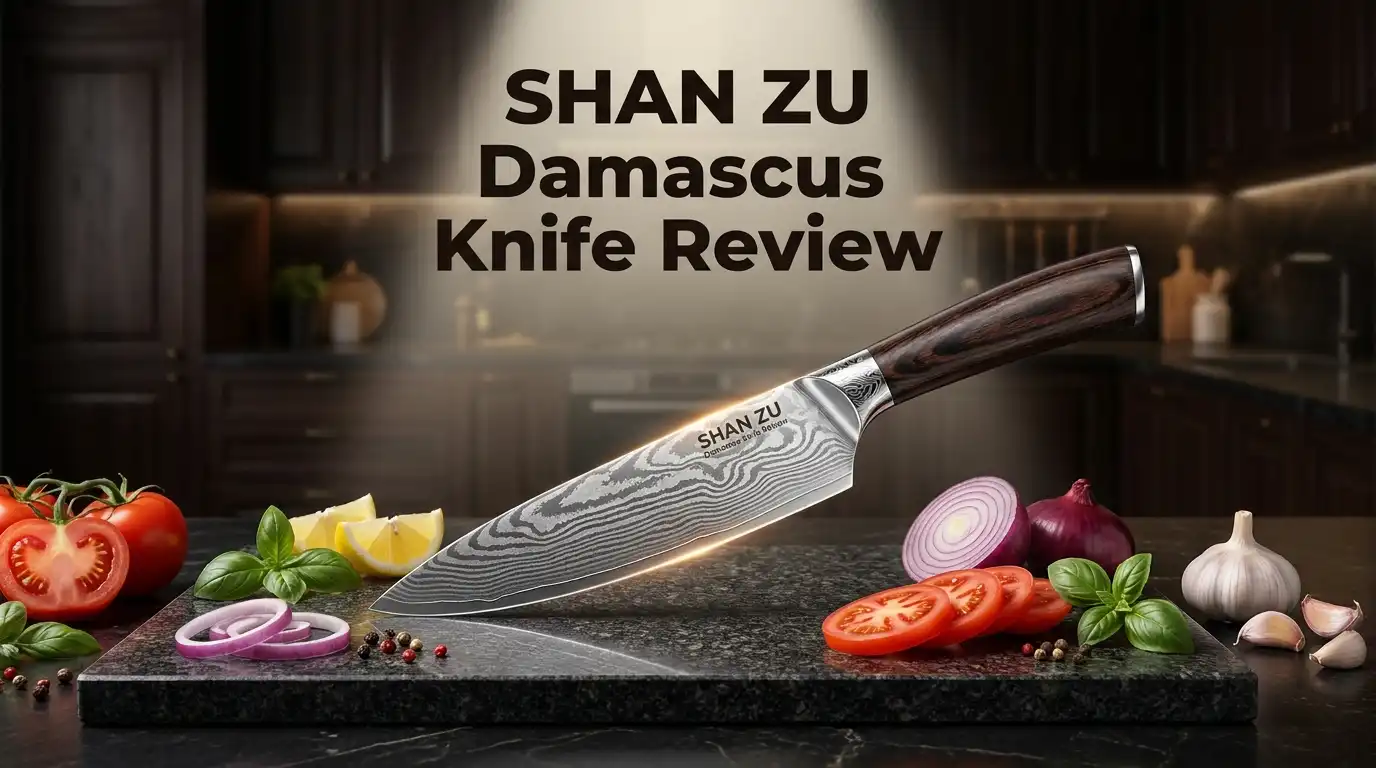
SHAN ZU Damascus Knife Review: Worth Buying?
If you keep sliding a dull blade through onions and end up with crushed, weepy pieces instead of clean slices, the fix is a sharper knife.
The SHAN ZU Damascus chef knife markets itself as a budget path to Japanese-style sharpness. Priced around $70, it promises a hard steel core, a striking 67-layer pattern, and a grippy handle. But does affordable Damascus actually cut, or is it just pretty steel?
I spent time with the knife, read through owner feedback from 2026, and dug into the specs. This review separates the marketing shine from real kitchen performance.
In a Nutshell
- Steel core: The blade uses a 10Cr15MoV Japanese steel core, rated around 60–62 HRC. Owners report it arrives genuinely sharp.
- Real Damascus layers: The 67 outer layers are true forged Damascus, not printed. They are mostly aesthetic, giving the wavy pattern.
- Handle: A military-grade G10 fiberglass handle resists heat, moisture, and cold. It feels secure in wet hands.
- Best for: Home cooks who want a good-looking, sharp knife on a budget, not competition-grade thinness.
- The catch: The blade runs thick and heavy. Slicing dense produce like carrots can feel like a fight.
- Consistency risk: Reported hardness varies between units. Quality control is hit or miss, so inspect on arrival.
What Is the SHAN ZU Damascus Chef Knife?
The SHAN ZU is an 8-inch Western-style chef knife built around a hardened Japanese steel core. The maker clads that core in 33 layers of stainless steel on each side, creating the 67-layer Damascus look.

- Japanese Steel Knife Core, Super Sharp: SHAN ZU chef's knife core is made of 10Cr15Mov Damascus Japanese steel that has...
- REAL Damascus Knife, not Lazer Etched: SHAN ZU Damascus chef knife layering sheets of carbon steel, and applies...

Last update on 2026-09-01 / Affiliate links / Images from Amazon Product Advertising API
The design targets a specific buyer: someone who wants a premium appearance without a premium price. It sits in the $30 to $70 range depending on the line.


Last update on 2026-04-08 / Affiliate links / Images from Amazon Product Advertising API
SHAN ZU is a Chinese brand, and the knives come from a large factory that supplies several similar labels. That fact is neutral on its own. What matters is how the finished tool performs on a cutting board, which the rest of this review covers.
The Steel and Blade Core
The heart of this knife is the 10Cr15MoV core, a steel comparable to the well-known VG10 used in many Japanese blades. SHAN ZU advertises a hardness of 60 HRC, plus or minus 2 points.
That tolerance matters. A 58 HRC blade and a 62 HRC blade behave differently on edge retention. Independent owner testing has found real units landing anywhere from 55 to 62 HRC.
On the high end, the steel holds an edge well and resists rust. One long-term owner reported no rust after eight years with monthly sharpening. On the low end, you still get a serviceable blade, just softer.
The takeaway is simple. The material is legitimate, but the heat treatment is not perfectly consistent between units.
Top 3 Alternatives for SHAN ZU Damascus Knife

- 8-piece Victorinox Fibrox cutlery set, hand-finished in Switzerland
- Includes: 4-inch Paring; 6-inch boning; 8-inch chef's; 8-inch bread; 10-inch slicing; 10-inch sharpening steel; kitchen...
Last update on 2026-07-19 / Affiliate links / Images from Amazon Product Advertising API
Victorinox Fibrox Pro 8-Inch Chef’s Knife

- Fujitora's (FU model number) is a mass produced item for a wide range of distribution.
- Size: Total Length: 14.2 inches (360 mm) (Blade Length: 9.4 inches (240 mm)))
Last update on 2026-06-09 / Affiliate links / Images from Amazon Product Advertising API
Tojiro DP Gyuto 8.2-Inch Chef Knife

- 【Professional Kitchen Knife SET】: Set includes: A 7INCH santoku knife and 7 inch nakiri knife, Sheath, Finger...
- 【Ultra-Sharp Blade】:Sharpness is key Hand-polished by craftsmen with decades of mirror finishexperience is...
Last update on 2026-07-19 / Affiliate links / Images from Amazon Product Advertising API
MOSFiATA 8-Inch Chef’s Knife with Finger Guard
Blade Geometry and Thickness
Here is the most honest criticism, and it comes up often. The SHAN ZU blade is thick with a flat grind. The spine is beefy and the profile looks more like a wide triangle than a slim taper.
That geometry has a cost. Food sticks to the blade and drags, and hard vegetables can feel like a struggle. A carrot may split ahead of the edge rather than slicing cleanly.
The 8-inch Damascus version can weigh anywhere from 180 to 280 grams. That is heavy for a chef knife. A standard German workhorse sits near 200 grams.
Some cooks love the extra heft and let the weight do the work. Others find it fatiguing over a long prep session. This is the single biggest factor in whether you will enjoy it.
The Handle and Grip
The G10 fiberglass handle is a genuine strong point. This material is almost impervious to heat, cold, and moisture, so it will not swell or crack like some wood handles.
The shape is ergonomic and full-tang, meaning the steel runs through the handle for balance. In practice, the grip feels secure even with wet or greasy hands.
The black G10 pairs cleanly with the Damascus pattern, so the look is cohesive. It reads as more expensive than the price suggests.
One note on balance. Because the blade is heavy, some of that weight sits forward of the handle. If you prefer a neutral or handle-heavy balance, this may feel tip-forward to you.
Unboxing and First Impressions
The knife ships in a magnetic gift box with a snug foam or fitted insert. It presents well and would make a solid gift straight out of the box.
Out of the wrapping, the blade arrives properly sharp. Multiple owners warn to be careful on first handling, which is a good sign for factory edge quality.
The Damascus pattern is visible and real, with a subtle wavy grain across the flat of the blade. It is not the deepest etch on the market, but it looks clean.
First impressions skew positive. The presentation and sharpness create a strong opening moment. The reservations only surface later, once you start cutting dense food on a real board.
Real-World Cutting Performance
On soft and medium tasks, the knife performs well. Tomatoes, herbs, boneless proteins, and soft fruit all slice cleanly thanks to the sharp factory edge.
The trouble starts with dense produce. Carrots, squash, and firm potatoes reveal the thick geometry. The blade wedges and food clings to the sides.
For everyday home cooking, most people never push past what the knife does well. One owner who uses it hours a day reports it stays sharp and satisfying.
So performance is task-dependent. If your cooking leans toward soft ingredients and quick prep, you will likely be happy. If you break down hard vegetables daily, a thinner-ground blade will serve you better.
Edge Retention and Sharpening
Edge retention depends on the hardness you actually receive. Owners with the higher-HRC units report the edge lasts a long time between sharpenings.
Sharpening is straightforward. One long-term user maintains it with 1000/6000 grit stones once a month and stays happy. The 10Cr15MoV steel takes an edge without special tools.
Because the steel is not exotic, you do not need diamond plates or unusual equipment. Standard whetstones handle it fine, which lowers the cost of ownership.
If you receive a softer unit, expect to touch up the edge a little more often. It will still sharpen easily, it just will not hold as long. A honing rod between sharpenings helps either way.
Durability and Corrosion Resistance
The stainless cladding and hardened core give this knife solid corrosion resistance. Multiple long-term owners report zero rust after years of use, even with regular dishwashing avoided.
The G10 handle adds to durability. It does not absorb water, so it resists the loosening and cracking that plague cheaper wood handles.
Hand washing is still the right move. Like any hardened blade, it should never go in the dishwasher, where heat and detergent damage the edge and finish.
With basic care, this knife lasts. The steel and handle are the two parts owners praise most for longevity, and that consistency across years of feedback is reassuring.
Downsides and Who Should Skip It
Time to be blunt about flaws. The thick blade geometry is the main weakness. Serious cooks who value thin, gliding cuts will find it clumsy on hard vegetables.
Quality control varies. Some buyers received faulty or shipping-damaged units, and customer service across the sea can be slow. Inspect your knife immediately on arrival.
The hardness inconsistency means you might get a great blade or a middling one. There is a real element of luck.
Skip this knife if you are a professional or knife enthusiast chasing performance, if you do heavy daily vegetable prep, or if you dislike a heavy, tip-forward feel. Those users should spend more on a thinner Japanese gyuto.
Who Should Buy the SHAN ZU Damascus Knife
This knife fits the home cook who wants a sharp, good-looking blade without spending $150 or more. That is a large and reasonable group.
It suits people who cook mostly with soft to medium ingredients and enjoy a knife with some weight behind it. If you like heft, the balance works in your favor.
It also makes a strong gift. The magnetic box, the Damascus pattern, and the out-of-box sharpness create a premium impression for a modest price.
If you accept the thick grind and the small QC gamble, the value is genuinely good. You are paying for legitimate materials and looks. Just go in knowing it is a budget performer, not a precision instrument.
Final Verdict
The SHAN ZU Damascus chef knife is worth buying for the right person. It delivers real Damascus looks, legitimate steel, a durable G10 handle, and a sharp factory edge at a fair price.
Its weaknesses are honest and predictable. The thick geometry fights dense produce, the weight tires some hands, and unit consistency is imperfect.
Match those traits to your cooking. A home cook who wants beauty and everyday sharpness will be pleased. A performance-focused user will want something thinner.
For most kitchens, it earns its spot on the counter. Just inspect it on arrival and keep your expectations set to budget, not boutique.
Frequently Asked Questions
Is the SHAN ZU Damascus pattern real or printed?
On their Damascus lines, the 67 layers are real forged Damascus, not a printed etch. SHAN ZU is honest about which products are genuine versus decorative. The pattern is mostly aesthetic, since the outer layers add structure rather than cutting performance. The hard core does the actual cutting work.
What steel does the SHAN ZU chef knife use?
The core is 10Cr15MoV Japanese steel, comparable to VG10. It is rated near 60 HRC, though real units vary. This steel resists rust and takes a sharp edge with standard whetstones, so you do not need special sharpening tools.
Can the SHAN ZU knife go in the dishwasher?
No. Hand wash and dry it immediately. Dishwasher heat and detergent damage the edge and dull the Damascus finish. Owners who hand wash report no rust even after many years, so proper care directly affects how long it lasts.
Is the SHAN ZU knife good for beginners?
Yes, with one caveat. It arrives very sharp, so handle it carefully at first. Beginners who cook soft and medium ingredients will enjoy it. If you cut hard vegetables daily, the thick blade may frustrate you as skills grow.
How does it compare to a Victorinox or Tojiro?
The Victorinox Fibrox is lighter and thinner, better for fast prep but plainer. The Tojiro DP offers a thinner Japanese grind for cleaner cuts. The SHAN ZU wins on looks and value but trails both on pure cutting geometry.
Is the SHAN ZU Damascus knife worth the money?
For a home cook wanting style and sharpness on a budget, yes. You get legitimate steel and a durable handle for around $70. It is not a precision tool, so professionals should look elsewhere. Set expectations to budget quality and it delivers.

Hi, I’m Liza Jensen, your culinary companion here at Recipe by Liza. 🍳🥗Cooking has always been my passion—I find joy in every whisk, every sizzle, and every aromatic spice. As a home cook and recipe developer, I’ve explored flavors from around the world, creating dishes that warm hearts and tantalize taste buds.Join me on this flavorful journey! Let’s swap kitchen stories, share tips, and celebrate the magic of food together.