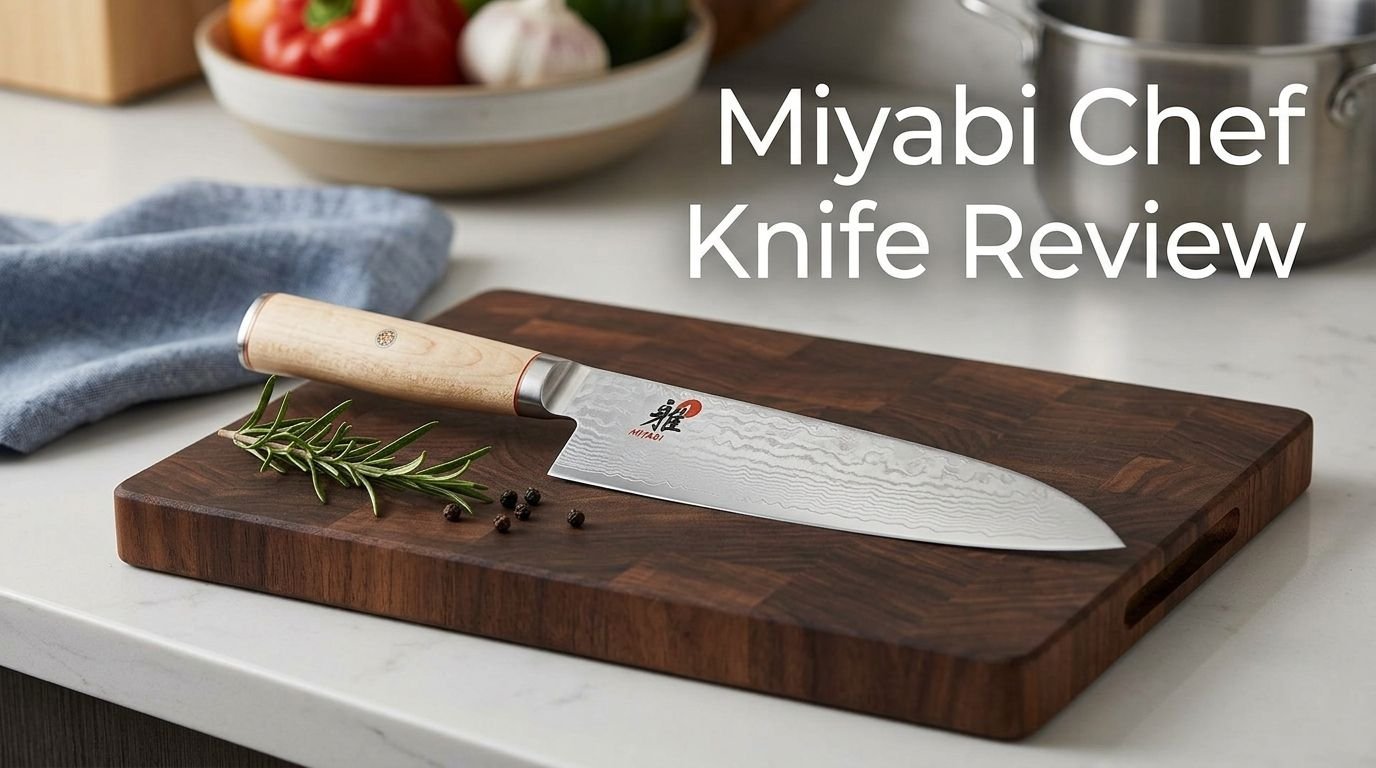
Miyabi Chef Knife Review 2026: Worth Your Money?
You clicked on this review for a reason. Maybe you are tired of dull knives that crush your tomatoes. Maybe you heard whispers about Miyabi knives and their razor sharp edges. Or maybe you just want to upgrade your kitchen game with a true Japanese blade.
Miyabi chef knives sit at the crossroads of Japanese tradition and German engineering. They are made in Seki, Japan, the historic capital of blade making.
The brand is owned by Zwilling J.A. Henckels, one of the oldest knife companies in the world. That combination creates something special.
Key Takeaways
- Miyabi chef knives are made in Seki, Japan using a 100 step, 42 day process. Each blade is hand finished by skilled craftsmen using traditional sword making techniques passed down for centuries.
- The steel quality is outstanding. Miyabi uses SG2 micro carbide powder steel (63 HRC), FC61 fine carbide steel (61 HRC), and VG10 super steel (60 HRC) across its different lines. These steels hold an edge far longer than most competitors.
- The Honbazuke hand honing process gives these knives a 9.5 to 12 degree cutting edge. That is nearly half the angle of most German knives and even sharper than many other Japanese brands like Shun (16 degrees).
- Multiple series are available at different price points. The Koh and Evolution start around $120, the Kaizen II sits near $150, and premium lines like the Birchwood and Black range from $300 to $400.
- Miyabi knives are lightweight and thin. Most 8 inch chef knives weigh around 6 ounces with a spine thickness of about 1.6 to 2mm. They glide through food with very little effort.
- These knives require proper care. You cannot put them in a dishwasher. You need to hand wash them, store them safely, and sharpen them with a whetstone or system that supports narrow blade angles.

- Revolutionary FC61 steel core features fine carbide distribution and is protected by a durable 48 layers of damast steel
- Fine carbide distribution creates a razor-sharp and durable blade with a 61 Rockwell hardness
Last update on 2026-09-19 / Affiliate links / Images from Amazon Product Advertising API
Miyabi Kaizen II 8 Inch Chef’s Knife
The Miyabi Kaizen II is one of the most popular knives in the entire Miyabi lineup. It uses FC61 fine carbide steel with a hardness rating of 61 HRC. This steel is a proprietary blend created for Miyabi, based on Sandvik 13C26 steel.
The blade features a 48 layer flower Damascus pattern that looks stunning. It is not just for show. The Damascus overlay protects the hard steel core and adds strength to the blade. The knife comes with a black Pakkawood handle that has an oval shape for a comfortable grip.


Last update on 2026-04-08 / Affiliate links / Images from Amazon Product Advertising API
At around $150, the Kaizen II offers a strong balance of price and performance. The blade is hand honed using the traditional Honbazuke process, which gives it a razor sharp 9.5 to 12 degree edge. That is sharper than a Shun Classic right out of the box.
One thing to note about the Kaizen II is its slightly taller heel compared to the original Kaizen. This creates a more pronounced curve along the blade. Many cooks find this helpful for rocking motions during chopping. The full tang construction gives the knife solid balance and control.
Miyabi Birchwood SG2 8 Inch Chef’s Knife

- G2 micro carbide powder steel
- Authentic thin Japanese blade profile
Last update on 2026-09-19 / Affiliate links / Images from Amazon Product Advertising API
The Miyabi Birchwood is the flagship of the Miyabi collection. It uses SG2 micro carbide powder steel with an impressive 63 HRC hardness rating. That makes it one of the hardest kitchen knives you can buy.
The blade is wrapped in a 100 layer flower Damascus pattern that creates a beautiful visual effect. The handle is made from Karelian Birch, a rare wood known for its distinctive grain patterns. Every handle looks unique because of the natural wood variations.
This knife also features a Hamon edge, which is a visible line on the blade created by differential hardening. It is the same technique used on traditional Samurai swords. The Birchwood glides through vegetables, proteins, and herbs with almost zero resistance.
At around $300, it is a serious investment. But the SG2 steel holds its edge significantly longer than VG10 or FC61. If you want the best cutting performance Miyabi offers in a gorgeous package, the Birchwood is hard to beat.
What Makes Miyabi Chef Knives Different
Miyabi knives stand apart from other brands for several clear reasons. Every single knife goes through a 100 step, 42 day process before it reaches your kitchen. That is not a marketing gimmick. The process includes forging, shaping, heat treating, ice hardening, and hand finishing.
The Cryodur or Friodur ice hardening process is a key part of the manufacturing. Blades are heated, cooled to room temperature, and then frozen to extreme temperatures (as low as minus 196 degrees Fahrenheit for Cryodur treated blades). This locks in the steel’s hardness and sharpness.
The Honbazuke hand honing is another defining feature. Each blade goes through three steps. First, it is coarsely ground with a vertical whetstone. Then it is fine honed with a horizontal whetstone. Finally, it is polished with a leather belt. This process creates the famous 9.5 to 12 degree cutting edge.
Top 3 Alternatives for Miyabi Chef Knife
Shun Classic 8 Inch Chef’s Knife

- JAPANESE CHEF KNIFE: The Shun Classic 8-inch Chef's Knife is expertly designed for a variety of kitchen tasks, from...
- PIONEERING EXCELLENCE: Bring home a piece of the renowned Classic Series – the original authentic Japanese cutlery...

Last update on 2026-09-19 / Affiliate links / Images from Amazon Product Advertising API
Tojiro DP 8.2 Inch Chef’s Knife

- Professional Chef Knife
- Made in Japan
Last update on 2026-09-19 / Affiliate links / Images from Amazon Product Advertising API
Dalstrong Shogun Series 8 Inch Chef Knife

- EVERYDAY MEAL PREP: Dice onions, mince herbs, slice vegetables, and portion boneless meat with an 8-inch chef knife...
- PRECISE SLICING: A hand-finished 8–12° edge per side supports fine cuts, while the hammered blade finish helps reduce...
Last update on 2026-09-19 / Affiliate links / Images from Amazon Product Advertising API
Miyabi Chef Knife Steel Types Explained
Miyabi uses three main types of steel across its knife collections. Understanding these steels helps you pick the right knife for your needs.
SG2 Micro Carbide Powder Steel is the top tier option. It has a Rockwell hardness of 63 HRC. SG2 stands for Super Gold 2, developed by the Takefu Steel Company. It offers exceptional edge retention and excellent corrosion resistance. You will find it in the Birchwood, Artisan, and Mizu lines.
FC61 Fine Carbide Steel is Miyabi’s mid range option. It is a proprietary version of Sandvik 13C26 steel with a hardness of 61 HRC. It performs very well for its price point and appears in the Kaizen II, Koh, and Evolution lines.
VG10 Super Steel appears in the original Kaizen line. It has a hardness of 60 HRC and is widely used by premium Japanese knife brands. VG10 offers good edge retention and corrosion resistance, though it can be slightly more prone to chipping than SG2.
Handle Design and Comfort
Miyabi offers several handle materials and shapes across its different knife lines. This variety lets you choose a knife that fits your hand perfectly.
The Birchwood line features handles made from Karelian Birch. This is a rare wood with swirling grain patterns. Each handle is truly one of a kind. The D shaped profile fits naturally in your hand and feels warm and organic.
The Kaizen II uses black Pakkawood handles. Pakkawood is a wood and resin composite. It resists bacteria, handles moisture well, and stays durable over years of use. The oval shape provides a secure and comfortable grip even with wet hands.
The Evolution and Koh lines use POM (polyoxymethylene) or Pakkawood handles. POM is a hard thermoplastic that is extremely durable and hygienic. It is the most affordable handle option, and it feels smooth and solid in your hand.
Sharpness and Edge Retention
Sharpness is where Miyabi knives truly shine. The 9.5 to 12 degree blade angle is among the thinnest you will find on any kitchen knife. Most German knives have a 15 to 17 degree angle. Shun knives use a 16 degree angle. Miyabi cuts that nearly in half.
This thin angle means the blade slices through food with minimal resistance. Tomatoes, onions, herbs, and delicate fish all cut cleanly without crushing or tearing. The feeling is similar to cutting with a scalpel.
Edge retention depends on the steel type. SG2 steel knives (63 HRC) hold their edge the longest. You can go weeks of regular home cooking before needing to sharpen. FC61 steel (61 HRC) also performs very well. VG10 steel (60 HRC) is good but may need sharpening sooner than the other two.
The Cryodur and Friodur ice hardening processes play a big role here. By freezing the blade during manufacturing, Miyabi locks in the steel’s hardness and creates a more uniform molecular structure. This directly translates to longer lasting sharpness in daily use.
Cutting Performance in the Kitchen
So how does a Miyabi chef knife actually perform during real cooking tasks? The short answer is exceptionally well.
The thin blade profile means this knife excels at precision cutting. Julienne cuts, brunoise, and chiffonade all come out clean and uniform. The lightweight design (around 6 ounces for an 8 inch blade) reduces hand fatigue during long prep sessions.
Vegetables are where you notice the biggest difference. Onions cut without tears because the blade is so thin it causes less cell damage. Tomatoes slice cleanly without squishing. Carrots and potatoes cut smoothly without wedging.
Proteins also cut beautifully. Chicken breasts, salmon fillets, and beef tenderloin all slice with precision. The thin blade creates minimal drag, so your cuts are cleaner and more accurate.
However, there are limitations. Miyabi knives are not built for hard foods like butternut squash, frozen items, or bones. The thin, hard blade can chip if you force it through resistant materials. For those tasks, a German style knife or a dedicated cleaver is a better choice.
Miyabi vs Shun: Which Is Better
This is one of the most common questions knife buyers ask. Both brands are popular, Japanese made, and sit in a similar price range. But there are clear differences.
Steel quality favors Miyabi. Shun uses VG MAX steel with a 60 to 62 HRC rating. Miyabi offers that level with VG10 but goes much higher with SG2 at 63 HRC and MC66 at 66 HRC. If you want the hardest possible blade, Miyabi has more options.
Blade angle also favors Miyabi. Shun knives have a 16 degree double bevel. Miyabi knives have a 9.5 to 12 degree double bevel. That is a significant difference in sharpness right out of the box.
Finishing quality favors Miyabi as well. Every Miyabi knife is hand finished with rounded spine edges, smooth transitions, and careful attention to small details. Shun uses a mix of machine and hand finishing.
Shun wins on handle size. Shun handles tend to be slightly larger and more comfortable for people with bigger hands. Miyabi handles are smaller and may feel cramped for some users.
Price is roughly comparable for mid range models. A Shun Classic 8 inch chef knife costs about $150 to $170. A Miyabi Kaizen II costs about $150. But Miyabi gives you harder steel and a thinner edge at that same price point.
Build Quality and Craftsmanship
The build quality of Miyabi knives is exceptional. These are not mass produced knives stamped out on an assembly line. Each one is individually forged and hand finished in Seki, Japan.
The attention to detail is visible everywhere. The spine edges are rounded and smooth. There are no burrs or rough spots anywhere on the blade or handle. The transition from blade to bolster to handle is seamless.
The mosaic pin found on several Miyabi handles is not a simple decorative pin. It is hand assembled from different metals like copper, steel, and bronze. Each piece is fitted by hand. This kind of detail is rare at this price point.
The full tang construction runs through every Miyabi knife. The blade steel extends all the way into the handle, creating a solid and balanced feel. Combined with the partial bolster, this gives the knife a forward balance that many Japanese knife users prefer.
Damascus layered models show beautiful flower patterns that look impressive. But the layers also serve a functional purpose. They protect the hard core steel and add flexibility to the overall blade structure. This makes the knife more durable over time.
Miyabi Chef Knife Price and Value
Miyabi knives range from about $120 to $400 for an 8 inch chef knife. That is a wide range, and the value depends on which line you choose.
The Koh and Evolution lines start around $120 to $130. They use FC61 steel with a 61 HRC hardness. For this price, you get a hand finished Japanese knife that outperforms many competitors priced much higher. These are excellent entry points into the Miyabi brand.
The Kaizen II sits around $150. It adds a 48 layer Damascus overlay to the FC61 steel core. The Pakkawood handle is an upgrade over the POM handles found on cheaper models. This is the sweet spot for most buyers.
The Birchwood and Artisan lines use SG2 steel and cost $200 to $300. The Birchwood adds a Karelian Birch handle and 100 layer Damascus. The Artisan features a Cocobolo Pakkawood handle. These are premium knives at a fair price for the materials used.
The Black 5000MCD67 is the most expensive at around $400. It uses MC66 micro carbide steel at a staggering 66 HRC. The 133 layer Damascus overlay and blackened maple handle make it a collector’s piece that also performs beautifully.
Pros and Cons of the Miyabi Chef Knife
Every product has strengths and weaknesses. Here is an honest look at both sides of the Miyabi chef knife.
The biggest pro is the sharpness. The 9.5 to 12 degree edge combined with premium Japanese steel creates a blade that cuts like nothing else in this price range. You will notice the difference the first time you pick it up.
Build quality is another major pro. The hand finishing, 100 step process, and attention to detail make these knives feel premium. The Damascus patterns are gorgeous. The handles are comfortable and well crafted.
Edge retention is excellent, especially on SG2 steel models. You can cook for weeks before needing to resharpen. This saves time and effort compared to softer steel knives.
On the con side, the thin blade is fragile. You cannot use it on bones, frozen food, or very hard vegetables without risking chips. This is true of most Japanese knives, but it is worth remembering.
Sharpening requires specialized tools. A standard pull through sharpener will ruin the blade angle. You need a whetstone or a guided system that supports angles under 12 degrees.
The handles may be too small for people with larger hands. This is a common complaint among taller or larger framed users. Try before you buy if possible.
Final Verdict on the Miyabi Chef Knife
The Miyabi chef knife earns a strong recommendation in 2026. It delivers exceptional sharpness, beautiful craftsmanship, and outstanding edge retention across every price point in its lineup.
If you want the best value, go with the Miyabi Kaizen II. It gives you hand honed sharpness, a Damascus blade, and solid FC61 steel for around $150. If you want the ultimate Miyabi experience, the Birchwood SG2 is worth the extra investment for its SG2 steel and stunning handle.
These knives require care and respect. They are not indestructible workhorses. But if you treat them well, they will reward you with years of precise, effortless cutting.
A Miyabi chef knife is one of the best investments you can make for your kitchen. It makes cooking faster, more enjoyable, and more precise. If you have been on the fence, now is a great time to take the leap.
Frequently Asked Questions
Are Miyabi knives made in Japan?
Yes. All Miyabi knives are handcrafted in Seki, Japan. Seki has been a center for blade making since the 14th century. The city was originally known for Samurai sword production. Today, it is recognized as the home of modern Japanese cutlery. Miyabi is owned by the German company Zwilling J.A. Henckels, but all manufacturing happens in Japan by skilled Japanese craftsmen.
Is Miyabi better than Shun?
Both brands make excellent Japanese knives. However, Miyabi has an edge in steel hardness, blade angle, and hand finishing quality. Miyabi offers SG2 steel at 63 HRC, while Shun tops out at around 61 HRC with VG MAX. Miyabi also has a thinner blade angle (9.5 to 12 degrees versus 16 degrees for Shun). Shun handles tend to be slightly larger, which may suit some users better.
Can you put Miyabi knives in the dishwasher?
No. Never put a Miyabi knife in the dishwasher. The high heat, harsh detergents, and contact with other utensils can damage the blade edge and the handle material. Always hand wash with warm water and mild soap. Dry the blade immediately with a clean towel to prevent water spots or surface rust.
How often should I sharpen my Miyabi knife?
This depends on how often you cook. For regular home use, sharpening every 2 to 3 months is usually sufficient for SG2 steel models. FC61 and VG10 models may need sharpening slightly more often. Use a honing rod weekly to maintain the edge between sharpenings. A Japanese whetstone or guided rod sharpener is the best tool for restoring the thin edge angle.
Which Miyabi line is best for beginners?
The Miyabi Koh is an excellent starting point. It costs around $120 for an 8 inch chef knife and uses FC61 steel at 61 HRC. The Pakkawood octagon handle is comfortable and easy to grip. It gives you the Miyabi sharpness and quality at the most accessible price. The Kaizen II at $150 is also a strong beginner choice if you want the added beauty of a Damascus blade.
Are Miyabi knives worth the price?
Yes, Miyabi knives offer strong value at every price point. Even the most affordable models feature hand honed edges, premium steel, and careful finishing that you will not find from most competitors at similar prices. The higher end models like the Birchwood and Black are collector grade knives that also perform at a professional level.

Hi, I’m Liza Jensen, your culinary companion here at Recipe by Liza. 🍳🥗Cooking has always been my passion—I find joy in every whisk, every sizzle, and every aromatic spice. As a home cook and recipe developer, I’ve explored flavors from around the world, creating dishes that warm hearts and tantalize taste buds.Join me on this flavorful journey! Let’s swap kitchen stories, share tips, and celebrate the magic of food together.