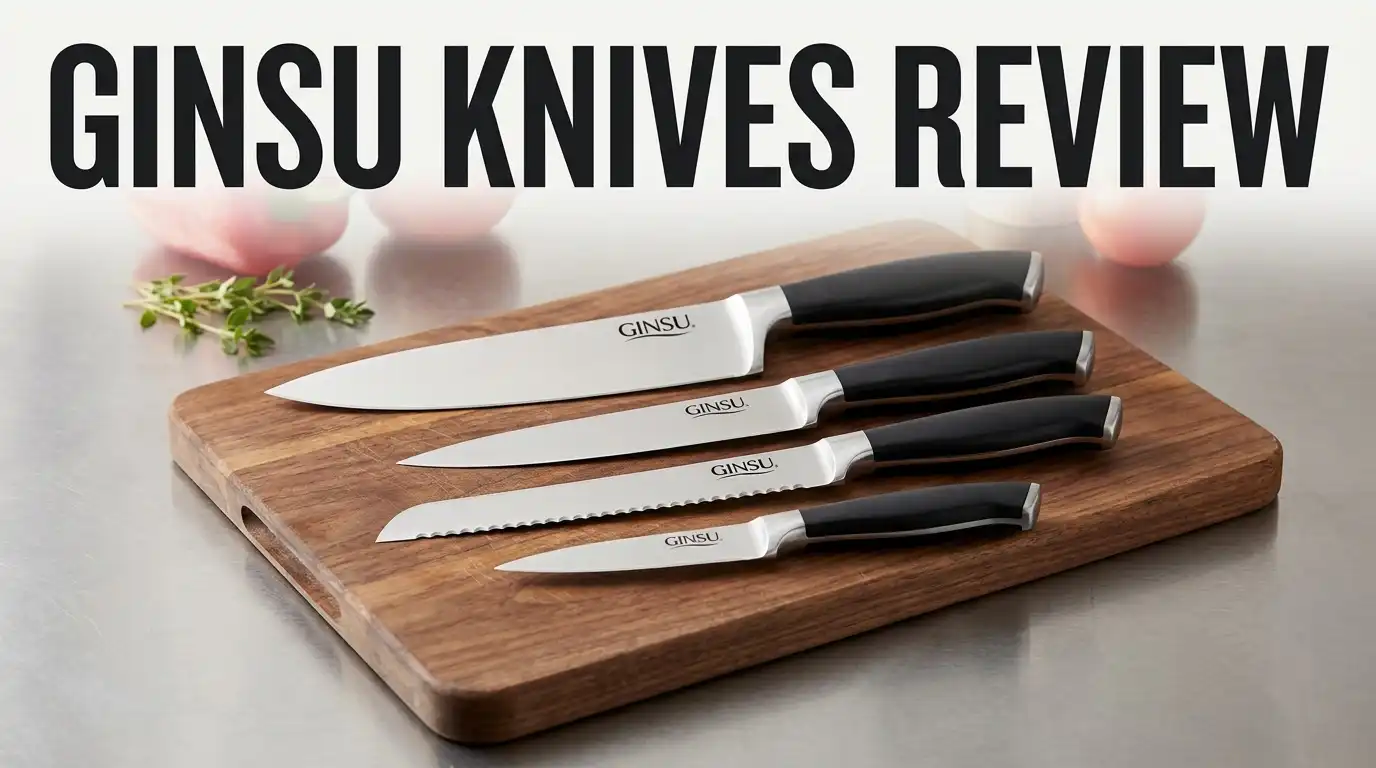
Ginsu Knives Review 2026: Still Sharp?
Ginsu built its name on late night TV, sawing through tin cans and tomatoes in the same breath. Decades later, the brand still sits on Amazon shelves at prices that look almost suspicious.
So the fair question in 2026 is simple. Do these budget knives actually cut, or are you paying for nostalgia?
I spent time with three Ginsu lines, read hundreds of owner reports, and compared them against Cuisinart and Chicago Cutlery. This review covers the unboxing, the steel, the sharpness, the failures, and the honest limits.
In A Nutshell:
- Ginsu is a real cutlery company, not a gimmick. Consumer Reports once tested the Chikara set against other cheap brands and it beat the competition on cutting performance. The infomercial reputation undersells the product.
- The Chikara Series is the line serious home cooks should buy. These are forged, full tang knives made from 420J Japanese stainless steel. They arrive sharp and feel balanced in hand.
- The Kiso Series is the easy care line. Every blade is serrated, every piece is dishwasher safe, and nothing needs honing. You trade precision for zero maintenance.
- 420J steel is the weak point. It resists rust well but sits near the bottom of the kitchen steel range. Edge retention is average, so a honing rod matters on the Chikara knives.
- Ginsu is not a lifetime heirloom set. Expect three to eight years of good service with normal home use. Professional cooks and knife enthusiasts will outgrow them quickly.
- Value is the real selling point. A full 12 piece forged set with a block often costs less than one German chef knife. For most families, that math wins.
Ginsu In 2026: What The Brand Sells Now

- Included Components: 8" Chef’s knife, 7" Santoku knife, 5" Utility knife, 5" Serrated utility knife, 3.5" Paring...
- Quality And Dependability: Ginsu Chikara forged knives arrive razor sharp and stay sharp longer than the competitors...
Last update on 2026-08-19 / Affiliate links / Images from Amazon Product Advertising API
Ginsu has been in kitchens for over 40 years. The company still operates at ginsu.com and sells through Amazon, Walmart, and Home Depot.
The current lineup splits into three families. Chikara, Kiso, and Daku.


Last update on 2026-04-08 / Affiliate links / Images from Amazon Product Advertising API
Chikara means “power” in Japanese. This is the forged line with fine edge blades, a honing rod in the bigger sets, and a wood or bamboo block.
Kiso means “fundamental.” Ginsu also markets this as the Essential Series in some listings, which confuses shoppers constantly.
Kiso knives are stamped rather than forged. Every blade carries a serrated edge, and the whole set goes in the dishwasher.
Daku is the newest and simplest family. It uses what Ginsu calls Symmetric Edge Technology and targets buyers who want steak knives or a small prep set at the lowest price.
One thing to understand clearly. Ginsu no longer makes the original 1970s knife you may remember. The old serrated wood handle model is gone from the main catalog.
The brand also backs the Chikara and Kiso lines with a limited lifetime warranty. That warranty covers defects, not dullness, so read the terms before you expect a free replacement.
Colors matter more than you would think in these lines. Kiso sets ship in red, purple, blue, and orange handles, and stock rotates fast.
Bottom line on the brand. Ginsu occupies the honest budget tier and does not pretend to compete with Shun or Wusthof.
The Unboxing Experience: What Actually Arrives
The box is plain brown cardboard with a printed sleeve. Nothing fancy, and that matches the price.
Inside, the block sits in a molded foam cradle. Each knife comes in its own cardboard sheath, taped shut, which takes a few minutes to strip.
My first impression was the smell of the bamboo block. It has a mild raw wood scent that fades after a day on the counter.
The block itself feels lighter than a premium hardwood block. It does not slide around, but it also does not feel heavy or planted.
Slot spacing is tight. The chef knife needs a straight push, and a careless angle will scrape the spine against the wood.
The knives arrive genuinely sharp. I sliced a ripe tomato with the 8 inch chef knife straight out of the wrapper and the skin gave way without pressure.
The honing rod is the weakest looking item in the box. It feels thin compared to rods from mid range brands.
Kitchen shears in the Chikara sets pull apart for cleaning, which is a nice touch at this price.
One small annoyance. The handle stickers leave residue, so plan on a warm water and soap scrub before first use.
Assembly is zero. Slot the knives, place the block, and you are cooking in five minutes.
For a set that costs less than a nice dinner out, the presentation punches above its weight.
Ginsu Chikara Series Forged 8 Piece Japanese Knife Set
This is the set I recommend to most people who cook daily. It covers the real work without filling your counter with steak knives you rarely touch.
You get an 8 inch chef knife, a 7 inch santoku, a 5 inch utility knife, a 5 inch serrated utility knife, a 3.5 inch paring knife, a honing rod, kitchen shears, and the block.
The 8 inch chef knife carries this set. It has enough belly for rocking cuts and enough weight to push through a butternut squash without complaint.
The 7 inch santoku surprised me. It handles onions and cabbage better than the chef knife thanks to the flatter edge profile.
Blades are forged 420J Japanese stainless steel with a full tang. The bolster gives your pinch grip a solid place to sit.
Fit and finish are decent, not perfect. On my set, one rivet sat slightly proud of the handle scale, noticeable to the thumb but harmless.
Edge retention is where reality bites. After roughly two weeks of daily prep, the chef knife needed the honing rod to feel new again.
Hand washing is required here. The listing says dishwasher safe on some pages, but hot detergent cycles will dull these fine edges and dry out the handles.
Weight sits in a comfortable middle. Heavier than Kiso, lighter than a German forged knife, which makes long prep sessions less tiring.
Pros
- Arrives razor sharp and cuts cleanly through soft produce and boneless protein
- Forged full tang construction with a real bolster and balanced feel
- Honing rod and shears included, so nothing extra to buy
- Covers every core kitchen task with five knives instead of fifteen
- Excellent price for a forged set with a wood block
Cons
- 420J steel loses its edge faster than higher grade stainless
- Hand wash only, which frustrates buyers who expected dishwasher use
- No boning or bread knife in this configuration
- Honing rod feels thin and basic
- Minor finishing flaws appear on some units
Ginsu Chikara Series Forged 12 Piece Japanese Knife Set

- Included Components: 8” Chef Knife, 7” Santoku Knife, 5” Utility Knife, 5” Serrated Utility Knife...
- Quality And Dependability: Ginsu Chikara forged knives arrive razor sharp and stay sharp longer than the competitors...
Last update on 2026-08-19 / Affiliate links / Images from Amazon Product Advertising API
The 12 piece set is the 8 piece set plus four 4.5 inch steak knives. That is the entire difference.
If you host dinners or your family eats steak often, this is the smarter buy. The upcharge over the 8 piece set is usually small.
You get the 8 inch chef knife, 7 inch santoku, 5 inch utility, 5 inch serrated utility, 3.5 inch paring knife, four steak knives, honing rod, shears, and a bamboo or toffee stained block.
The steak knives are the honest weak link. They are stamped rather than forged, so they feel lighter and cheaper than the main blades.
They still cut a medium rare ribeye without tearing. Just do not expect them to match the prep knives in hand feel.
The block has 12 slots and a wider footprint. Measure your counter depth before ordering, since it takes real space next to a backsplash.
Balance on the chef knife stays the same as the smaller set. That consistency is a good sign about the manufacturing.
I tested the serrated utility knife on a crusty sourdough loaf. It works for a sandwich loaf, though it is too short for a full bakery boule.
Price sits in the range where a single premium chef knife would cost the same. That comparison explains the popularity.
Pros
- Adds four steak knives for a small price increase
- Same forged prep knives as the 8 piece set
- Bamboo and toffee block options suit different kitchens
- Strong value for families and frequent hosts
- Limited lifetime warranty on manufacturing defects
Cons
- Steak knives are stamped, not forged, and feel noticeably cheaper
- Block takes up significant counter space
- Still no dedicated bread knife or boning knife
- Fine edges need regular honing to stay useful
- Hand wash only for best blade life
Ginsu Kiso 14 Piece Knife Set With Black Block

- Included Components: 8” Chef Knife, 8” Slicing and Carving Knife, 7” Santoku Knife, 5” Boning Knife...
- Easy To Maintain: Backed by our exclusive scalloped serration, Ginsu’s forever sharp knives make chopping, slicing...
Last update on 2026-08-19 / Affiliate links / Images from Amazon Product Advertising API
The Kiso set solves one problem very well. It removes maintenance from the equation entirely.
You get an 8 inch chef knife, an 8 inch slicing and carving knife, a 7 inch santoku, a 5 inch boning knife, a 4.5 inch utility knife, six steak knives, a 3.5 inch paring knife, and a black block.
Every blade is serrated. That single design choice is why these knives never need sharpening.
Serrated teeth keep biting even after the fine points wear down. A dull serrated blade still saws through a tomato while a dull straight edge just squashes it.
The tradeoff is precision. You cannot get a clean paper thin slice of garlic or a tidy dice of shallot with a serrated edge.
Handles come in red, purple, blue, and orange. The color is bright and plastic, which some buyers love and others hate on sight.
These are stamped blades, so they feel light. The upside is easy handling for smaller hands and older cooks.
Dishwasher use is fine here. Ginsu built the line around that promise and owners confirm the blades survive years of cycles.
The boning knife is the standout piece. Its serrations grip chicken skin and separate joints with very little effort.
Cutting boards take a beating from serrated edges. Expect more scoring on wood and plastic boards than with the Chikara knives.
Pros
- Never needs sharpening or honing thanks to serrated edges
- Fully dishwasher safe, which saves real time
- Full tang construction despite the low price
- 14 pieces including six steak knives and a boning knife
- Lightweight and easy for beginners to control
Cons
- Serrated edges cannot produce clean, precise slices
- Blades tear delicate items like tomatoes if you push too fast
- Stamped steel feels thin and lacks a bolster
- Bright plastic handles look cheap on a nice counter
- Chews up cutting board surfaces faster
Top 3 Alternative for Ginsu Kiso 14 Piece Knife Set

- Complete Knife Set: Enhance your kitchen with the Cuisinart Triple Rivet Collection 15-Piece Knife Block Set, including...
- Precision Forged Blades: Crafted from superior high-carbon stainless steel, our blades are designed for accuracy and...

Last update on 2026-08-19 / Affiliate links / Images from Amazon Product Advertising API
Cuisinart 15 Piece Triple Rivet Knife Block Set

- 18 PIECES: This Chicago Cutlery set is made with durable, high quality stainless steel blades that resist stains and...
- BUILT IN SHARPENER: With a unique built-in sharpener in the acacia wood block, the Insignia knife set makes it easy to...
Last update on 2026-08-19 / Affiliate links / Images from Amazon Product Advertising API
Chicago Cutlery Insignia Steel 18 Piece Knife Block Set

- 14-piece knife set incluedes: (1) 8'' Chef's knife, (1) 8'' Slicing knife, (1) 8'' Bread knife, (1) 5.5'' Utility knife...
- High carbon stainless-steel blades for precision results and lasting sharpness
Last update on 2026-07-11 / Affiliate links / Images from Amazon Product Advertising API
Amazon Basics 14 Piece High Carbon Stainless Steel Knife Set
Blade Steel And Sharpness: What 420J Means
Ginsu uses 420J stainless steel across the Chikara and Kiso lines. This is the single most important spec to understand.
420J is a low carbon stainless steel. It contains enough chromium to resist rust and stains very well.
Low carbon content means low hardness. On the Rockwell scale, 420J typically lands around 50 to 54 HRC.
Premium Japanese knives sit near 60 HRC or higher. That gap explains everything about how these knives behave.
Softer steel takes an edge quickly and easily. A few passes on a honing rod restores useful sharpness in seconds.
Softer steel also loses that edge quickly. Under daily use, you will hone weekly rather than monthly.
The upside deserves credit. Softer steel resists chipping, so dropping a Ginsu on a tile floor rarely ruins the blade.
Rust resistance is genuinely strong. I left a wet Chikara paring knife on the counter overnight and found no spotting.
Sharpening is easy for beginners. A basic pull through sharpener or a 1000 grit stone brings the Chikara blades back without skill.
The Kiso serrated blades cannot be sharpened at home in any practical way. That is the entire point of the serration.
So set your expectations correctly. These knives get sharp fast and get dull fast, and that cycle is the deal you are accepting.
Handles, Balance And Comfort In Hand
Handle feel decides whether a knife gets used or ignored. Ginsu handles differ sharply between lines.
Chikara handles use black polymer scales with three visible rivets and a full bolster. They feel dense and slightly grippy when dry.
The pinch grip works well on the 8 inch chef knife. Your thumb and forefinger find the blade spine naturally.
Wet hands change the story. The Chikara polymer gets slick with oil or chicken fat, so a towel nearby is wise.
Balance sits just forward of the bolster. That gives the chef knife a mild forward bias, which helps chopping momentum.
Kiso handles are wider and made of lighter plastic. They include a textured section that holds up better when wet.
Smaller hands generally prefer Kiso. The lighter weight reduces fatigue during long prep sessions.
Larger hands often find the Kiso paring knife handle too short. Your palm hangs off the back end.
Neither line has a rounded spine. The squared edge on the blade spine presses into your index finger during heavy chopping.
That is a common budget knife shortcut. Mid tier brands round and polish the spine, and Ginsu does not.
Steak knife handles in both lines feel the cheapest of all pieces. They function fine but they will not impress dinner guests.
What Ginsu Knives Do Not Do Well
Every honest review needs this section. Here is where Ginsu falls short.
Edge retention is the biggest weakness. Reddit threads and long term owners consistently report that these blades will not hold a fine edge under heavy use.
Precision knife work suffers. If you want translucent slices of fish or fine brunoise dice, Ginsu will frustrate you.
The Kiso serrated design cannot do delicate work at all. It saws, and sawing tears soft flesh like ripe peaches.
Blocks are the second complaint. Slots wear loose over time, and the finish on bamboo blocks can lift near the base if water pools.
Handle durability varies. Some owners report loosening rivets after several years of dishwasher cycles on the Kiso line.
Customer service reports are mixed. Warranty claims work for clear manufacturing defects but rarely for dullness or handle wear.
Listing accuracy is another problem. The same Ginsu set appears under multiple names, colors, and piece counts, which makes comparison shopping confusing.
Do not buy these expecting heirloom quality. Ginsu knives are consumable tools, not investments.
Heavy tasks reveal the limits. Splitting a chicken through bone with the Chikara chef knife risks rolling the edge.
There is no left handed or specialty grind option. What you see is what ships.
If any of these limits matter to your cooking, spend more elsewhere. That is the fair conclusion.
Care, Cleaning And Dishwasher Rules
Care rules differ by line, and mixing them up shortens the life of your knives.
Chikara knives want hand washing. Warm water, a soft sponge, and immediate drying.
Never leave a Chikara knife soaking in the sink. The polymer handle scales expand and the rivets can loosen over time.
Hone before or after each heavy prep session. Six light passes per side on the included rod is enough.
Honing does not remove metal, it realigns the edge. Real sharpening comes every three to six months on a stone or with a pull through tool.
Kiso knives are dishwasher safe by design. Place them blade down in the basket so nobody reaches into a serrated edge.
Even so, hand washing extends handle life. Detergent is harsh on plastic over hundreds of cycles.
Both lines belong in the block, not in a drawer. Loose blades in a drawer chip and dull faster than anything else.
Cutting board choice matters. Wood and soft plastic protect the edge, while glass, stone, and ceramic destroy it.
Wipe the block interior with a dry cloth monthly. Crumbs and moisture collect in the slots.
Never cut frozen food or bone with the fine edge blades. The soft steel will roll or chip.
Follow these basics and a Chikara set will serve you well for years.
Ginsu Versus Cuisinart And Chicago Cutlery
Budget knife shopping usually comes down to these three brands. Here is how they separate.
Ginsu Chikara wins on construction for the price. Forged, full tang, real bolster, and a honing rod included.
Cuisinart Triple Rivet sets are lighter and stamped. They arrive sharp and look sleek, but the thin blades flex under pressure.
Cuisinart usually offers more pieces for less money. The 15 piece block set is a common comparison point.
Chicago Cutlery uses high carbon stainless steel, which holds an edge longer than 420J. That is a real advantage.
Chicago Cutlery handles feel bulkier. Their Insignia grip design guides your hand into a pinch grip, which beginners appreciate.
Amazon Basics sits at the bottom of the price ladder. It cuts acceptably for a year or two and then feels disposable.
On sharpness out of the box, Ginsu Chikara and Chicago Cutlery finish close together.
On maintenance freedom, Ginsu Kiso wins outright. No other major brand builds a full serrated dishwasher safe set this cheaply.
On long term edge quality, Chicago Cutlery takes it. On feel and balance, Ginsu Chikara takes it.
Pick based on your habits, not the piece count. A cook who hones weekly should buy Chikara.
A cook who never wants maintenance should buy Kiso. A cook who wants better steel should stretch to Chicago Cutlery.
Price And Value In 2026
Ginsu prices move constantly, so treat any figure as a range rather than a promise.
The Chikara 8 piece set typically lands in the middle two figure range. Consumer Reports tested it near 75 dollars years ago and it has stayed close to that zone.
The Chikara 12 piece set usually costs 20 to 40 dollars more. That is the best value jump in the entire lineup.
The Chikara 19 piece set adds a bread knife, cleaver, boning knife, carving knife, and eight steak knives.
Kiso 14 piece sets often sell for less than the Chikara 8 piece set. Stamped construction explains the gap.
Daku steak knife sets sit at the lowest price point and sell well as gifts.
Compare that against a single premium chef knife at 150 to 200 dollars. A full Ginsu set costs a fraction of one good knife.
The value case is strong for one specific buyer. Someone who cooks four to six nights a week and does not want a knife hobby.
The value case weakens for two groups. Enthusiasts who will replace these within a year, and light cooks who only need two knives.
Watch for coupon offers on Amazon. Ginsu runs percentage discounts on Chikara sets regularly.
Buy the set that matches your cooking, not the biggest box on sale. Extra steak knives you never use are not value.
Who Should Buy Ginsu And Who Should Skip It
Let me make this concrete.
Buy the Chikara set if you cook most nights, care about clean cuts, and accept weekly honing.
Buy the Kiso set if you want knives that survive the dishwasher and never need attention.
Buy the Daku steak set if you only need table knives that look decent and cut a ribeye.
Skip Ginsu entirely if you already own a quality chef knife and know how to sharpen it.
Skip it if you cook professionally. Restaurant volume destroys 420J steel quickly.
Skip it if you plan to hand down your knives. These are tools with a service life, not heirlooms.
New homeowners and first apartment cooks get the most from these sets. You get a complete kitchen for very little money.
Gift buyers do well here too. A 12 piece forged set with a block presents nicely for a wedding or housewarming.
Parents equipping a college kitchen should look at Kiso. Dishwasher safety and zero sharpening remove all the risk.
Knife hobbyists should look elsewhere. The soft steel will bore you within a month.
Anyone with hand strength limits should consider Kiso as well. The lighter blades and serrated edges reduce the force needed per cut.
Final Verdict: Are Ginsu Knives Worth It In 2026?
Yes, with clear conditions.
Ginsu delivers more knife per dollar than almost anything else on the market. The Chikara line especially punches above its price.
The forged construction, full tang, and comfortable balance are real. They are not marketing claims.
The 420J steel is the honest ceiling. You will hone often and sharpen a few times a year.
The Kiso line solves a different problem well. It gives busy households sharp enough knives with no upkeep at all.
Neither line will satisfy a knife enthusiast. That is fine, because neither line is priced for one.
I would buy the Chikara 12 piece set for a family kitchen. The steak knives justify the small upcharge.
I would buy the Kiso 14 piece set for a rental, a college apartment, or a cabin.
I would not buy Ginsu if my budget stretched to 200 dollars. At that level, one excellent chef knife plus a paring knife beats any full set.
Rating for the Chikara line: 4 out of 5 for value, 3 out of 5 for steel quality.
Rating for the Kiso line: 4.5 out of 5 for convenience, 2.5 out of 5 for precision.
That balance is the whole story. Ginsu still cuts, and it still costs very little.
Frequently Asked Questions
Are Ginsu knives good quality?
Ginsu knives are good quality for their price tier. The Chikara line uses forged full tang construction and 420J Japanese stainless steel. Independent testing has placed the Chikara set ahead of other cheap cutlery brands on cutting performance. They are not equal to premium Japanese or German knives.
Do Ginsu knives need sharpening?
The Chikara line needs honing and periodic sharpening because the blades have fine edges. The Kiso line has serrated edges and never needs sharpening. That serration is the reason the Kiso sets stay usable for years without tools.
Are Ginsu knives dishwasher safe?
Kiso knives are fully dishwasher safe. Chikara knives should be hand washed and dried immediately to protect the edge and the handle rivets. Some listings say dishwasher safe for Chikara, but hand washing extends their life significantly.
What steel do Ginsu knives use?
Both the Chikara and Kiso lines use 420J stainless steel. This steel resists rust and stains very well but has low carbon content, so it does not hold an edge as long as high carbon steel.
Which Ginsu series should I buy?
Choose Chikara if you cook often and want clean precise cuts. Choose Kiso if you want dishwasher safe knives with zero maintenance. Choose Daku if you only need affordable steak knives.
Are Ginsu knives made in Japan?
Ginsu uses Japanese steel in its blades, but the knives are manufactured overseas rather than in Japan. The brand is American and has operated for more than 40 years.
Do Ginsu knives come with a warranty?
The Chikara and Kiso lines carry a limited lifetime warranty. That coverage applies to manufacturing defects. It does not cover normal dulling, handle wear, or damage from misuse.
How long do Ginsu knives last?
With normal home use and basic care, expect three to eight years of good service. Many owners report much longer service from older Ginsu sets, though performance drops as the steel wears.

Hi, I’m Liza Jensen, your culinary companion here at Recipe by Liza. 🍳🥗Cooking has always been my passion—I find joy in every whisk, every sizzle, and every aromatic spice. As a home cook and recipe developer, I’ve explored flavors from around the world, creating dishes that warm hearts and tantalize taste buds.Join me on this flavorful journey! Let’s swap kitchen stories, share tips, and celebrate the magic of food together.