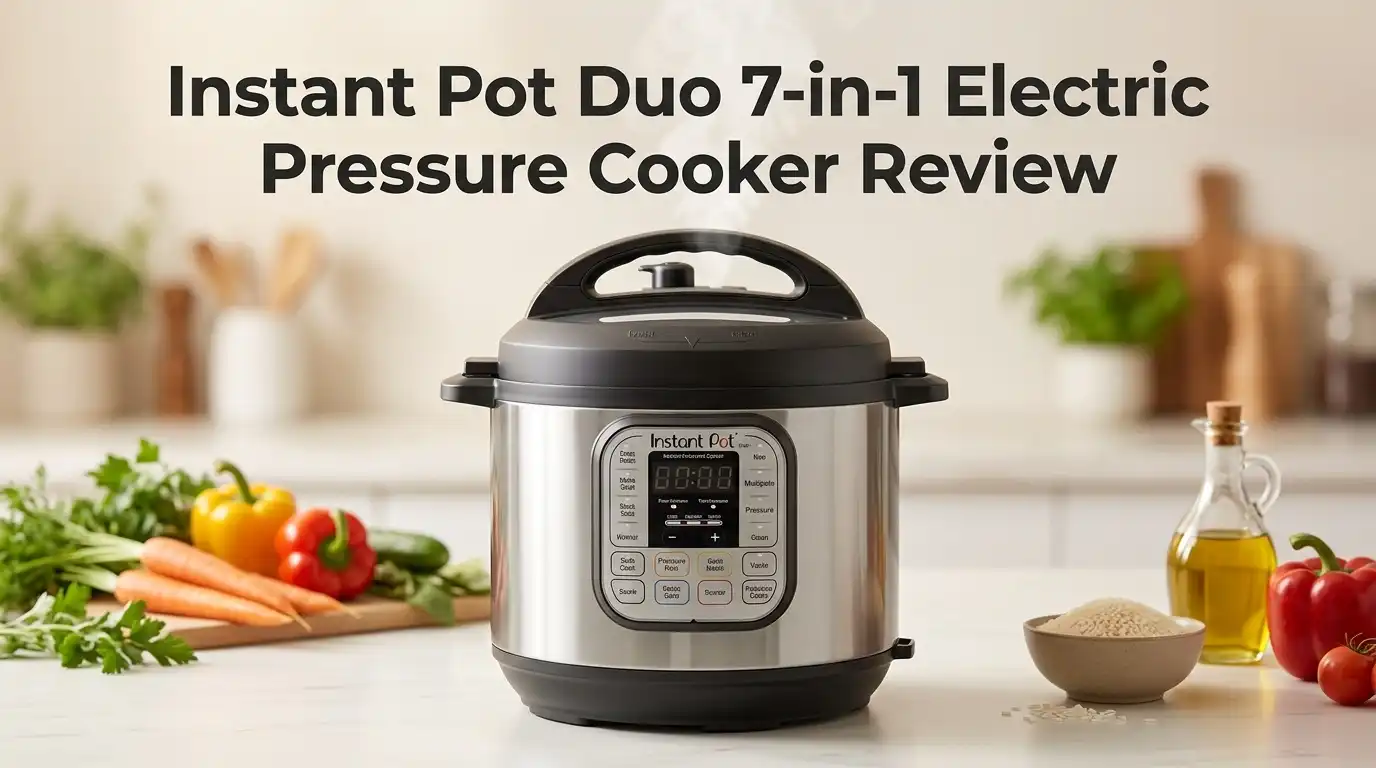
Instant Pot Duo 7-in-1 Electric Pressure Cooker Review 2026
The Instant Pot Duo has sat on kitchen counters for over a decade now. It still shows up in best seller lists every single year. That staying power raises a fair question in 2026.
Is this cooker still the smart pick, or has the rest of the market caught up? I bought one, cooked with it for weeks, and tracked every win and every annoyance.
This review covers the unboxing, the real cooking results, the cleaning routine, and the flaws nobody mentions in the marketing copy. You will know by the end whether this pot belongs in your kitchen.
In a Nutshell:
- The Duo does seven jobs well enough. It pressure cooks, slow cooks, sautés, steams, makes rice, cultures yogurt, and keeps food warm. None of these functions win a gold medal on their own, but together they replace several appliances and free up cabinet space.
- Pressure cooking is the real reason to buy. Dried beans finish in about 35 minutes with no soaking. Pot roast turns fork tender in roughly an hour. This one function alone justifies the price for most home cooks.
- The learning curve is real but short. Most people feel confused for the first three meals. After a week, the buttons make sense and the pressure release stops feeling scary.
- The slow cooker mode is the weakest link. It heats from the bottom and sides, not evenly like a dedicated crock pot. Your slow cooker recipes will need adjustment.
- Cleaning takes effort you should plan for. The sealing ring absorbs curry, chili, and garlic smells. You will want a second ring within a few months.
- Value in 2026 remains strong. The Duo usually costs far less than the Pro or Duo Plus, and the extra features on those models help a smaller group of cooks than the ads suggest.
What Is the Instant Pot Duo 7-in-1 Electric Pressure Cooker?

- 7 Cooking Functions: Pressure cook, slow cook, sauté, steam, make rice, yogurt, or simply keep your meal warm—all in...
- Customizable Smart Programs: Tackle every recipe with 13 one-touch options, from hearty soups to decadent cakes

Last update on 2026-06-09 / Affiliate links / Images from Amazon Product Advertising API
The Instant Pot Duo is an electric multicooker built around a sealed pressure chamber. A heating element sits under a removable stainless steel inner pot. A locking lid traps steam, pressure builds, and food cooks far faster than it would on a stovetop.
The name comes from seven core jobs. It works as a pressure cooker, slow cooker, rice cooker, steamer, sauté pan, yogurt maker, and food warmer.


Last update on 2026-04-08 / Affiliate links / Images from Amazon Product Advertising API
The 6 quart model handles most households. It draws 1000 watts and feeds roughly four to six people per batch. The 3 quart mini runs at 700 watts, and the 8 quart version pulls 1200 watts for bigger families.
The control panel keeps things simple on purpose. You get 13 one touch programs printed right on the face, plus manual pressure and time adjustment for everything else.
Instant Brands built the Duo as the entry model in a wide lineup. It sits below the Duo Plus, the Duo Crisp, and the Pro in price and in feature count.
What you lose at this level is mostly convenience polish. There is no sous vide setting, no automatic steam release, and the display shows numbers rather than plain text prompts.
What you keep is the part that matters most. The pressure cooking engine inside the Duo performs the same core task as the pricier models. The pot reaches high pressure around 10.2 to 11.6 psi, which is the standard range across the whole Instant Pot family.
Unboxing Experience and First Impressions
The box arrives heavier than expected. The 6 quart unit weighs close to 12 pounds with the inner pot in place, so plan for a two hand lift out of the carton.
Inside, the cooker sits inside a molded cardboard cradle with a plastic sleeve over the body. Everything is packed tightly, and no foam peanuts spill across the floor.
The accessories hide inside the inner pot. You get a steam rack with folding handles, a rice paddle, a soup spoon, and a plastic measuring cup.
The measuring cup surprises most first time buyers. It holds 180 ml, which follows the Japanese rice cup standard rather than a US cup. Ignore that detail and your rice ratios will be wrong.
The manual comes as a thick booklet with a small recipe section. It reads better than most appliance manuals, though the print size is tiny.
First impressions of the hardware are positive. The stainless steel band around the body feels solid, and the lid clicks into place with a satisfying chime.
The plastic parts feel like plastic, which is honest for the price. The lid handle, the base rim, and the control panel surround all use molded plastic rather than metal.
The first thing you should do is the water test. Pour in three cups of water, seal the lid, and run five minutes on high pressure. This confirms the ring seats correctly and teaches you what steam release sounds like before dinner is on the line.
Design, Build Quality, and Control Panel
The Duo measures roughly 12.2 inches deep, 13.4 inches wide, and 12.5 inches tall in the 6 quart size. It fits under most upper cabinets, but the lid needs vertical clearance to open.
The inner pot uses grade 304 stainless steel with a tri layer base. It has no nonstick coating, which means no flaking and no worry about scratched surfaces.
That bare steel is a double edged feature. It cleans up in the dishwasher and lasts for years, though food sticks more during sauté than it would on a coated pan.
The lid stores in a clever way. Slot the handle into the side notch and the lid stands upright next to the base instead of dripping on your counter.
The control panel uses physical buttons rather than a touch screen. Buttons survive wet fingers and greasy hands far better than glass panels do.
The LED display shows time and status codes in red digits. It tells you “On” while preheating and switches to a countdown once pressure builds.
Build quality holds up under daily use. The most common wear points are the sealing ring and the float valve, and both cost very little to replace.
One design gripe stands out. The steam release handle is loose by design, which feels broken until you read the manual and learn it is meant to wiggle.
Top 3 Alternative for Instant Pot Duo 7-in-1 Electric Pressure Cooker

- 9 Cooking Functions: Pressure cook, slow cook, sauté, sous vide, steam, sterilize, keep warm, make rice and...
- Customizable Smart Programs: Tackle every recipe with 15 one-touch options, from hearty soups to decadent cakes
Last update on 2026-06-09 / Affiliate links / Images from Amazon Product Advertising API
Instant Pot Duo Plus 9-in-1 Multicooker

- 10 Cooking Functions: Pressure cook, slow cook, sous vide, sauté, sterilize, cook yogurt and rice, bake, steam, or...
- Customizable Smart Programs: Tackle every recipe with 28 one-touch options covering all essential meals
Last update on 2026-06-09 / Affiliate links / Images from Amazon Product Advertising API
Instant Pot Pro 10-in-1 Pressure Cooker

- 7 Cooking Functions: Pressure cook, slow cook, sauté, steam, make rice, yogurt, or simply keep your meal warm—all in...
- Compact Yet Capable: A 3-quart capacity makes it perfect for small households or side dishes, and with 11 one-touch...
Last update on 2026-06-09 / Affiliate links / Images from Amazon Product Advertising API
Instant Pot Duo 7-in-1 Mini Electric Pressure Cooker
Key Specifications You Should Know
- 7 Cooking Functions: Pressure cook, slow cook, sauté, steam, make rice, yogurt, or simply keep your meal warm—all in...
- Customizable Smart Programs: Tackle every recipe with 13 one-touch options, from hearty soups to decadent cakes
Last update on 2026-06-09 / Affiliate links / Images from Amazon Product Advertising API
The 6 quart Duo holds 5.68 liters of total volume. Safe fill lines cut that down in practice, so plan on about two thirds capacity for most foods.
Pressure cooking maxes out around 11.6 psi on the high setting. The low setting runs closer to 5.8 psi for delicate items like fish and eggs.
The 13 preset programs cover common tasks. Soup, meat and stew, bean and chili, poultry, rice, multigrain, porridge, steam, sauté, slow cook, yogurt, keep warm, and pressure cook all get their own button.
Sauté offers three heat levels. Less handles simmering, Normal handles browning, and More handles searing and reducing.
The keep warm function holds food between 145 and 172 degrees Fahrenheit. It switches on automatically after most programs finish.
Delay start goes up to 24 hours. Use it for oatmeal in the morning, but skip it for meat and dairy that should not sit at room temperature.
The unit includes ten safety mechanisms. These cover lid locking, pressure regulation, temperature monitoring, and an anti block shield over the steam vent.
Power draw matters for older kitchens. At 1000 watts, the 6 quart Duo shares a circuit comfortably with most appliances, unlike some 1500 watt multicookers.
Everything except the base washes easily. The inner pot, lid, sealing ring, and rack are all dishwasher safe on the top rack.
How the Seven Cooking Functions Perform
Pressure cooking earns a clear A grade. Tough cuts, dried legumes, and whole grains all finish in a fraction of stovetop time with no babysitting.
Rice cooking scores a solid B. White rice comes out reliably fluffy, and brown rice needs only 22 minutes with a natural release.
Sauté works better than expected but has limits. It browns onions and sears cubed meat fine, though the narrow base means you must cook in batches.
Steaming performs well for vegetables and dumplings. The included rack sits high enough to keep food above the water line.
Yogurt making is quietly excellent. The pot holds a steady incubation temperature for eight hours, and homemade yogurt costs a fraction of store prices.
Keep warm does its job without drying food out too fast. Rice and stew hold nicely for an hour or two.
Slow cooking is the weak function. The Duo heats through the bottom and side walls rather than surrounding food gently, so results run hotter and less even than a dedicated slow cooker.
My honest advice is to treat the Duo as a pressure cooker that happens to do other things. Buy it for speed, and count the remaining functions as bonuses rather than replacements.
Real Cooking Tests in My Kitchen
I ran the same dishes I cook every week to see how the Duo handled ordinary life.
Dried black beans went in unsoaked with water, salt, and a bay leaf. Thirty five minutes at high pressure plus a natural release gave creamy beans with intact skins.
A three pound chuck roast was the biggest win. Sixty minutes plus a fifteen minute natural release produced meat that pulled apart with a fork.
Chicken breasts took eight minutes from thawed. They stayed juicy, though the texture leaned slightly firm compared with a pan sear.
Steel cut oats finished in four minutes with a ten minute natural release. That result changed my breakfast routine permanently.
Cheesecake worked, surprisingly. A 7 inch pan on the rack over water gave a crack free top after 35 minutes.
Hard boiled eggs came out easy to peel using the five, five, five method. Five minutes pressure, five minutes natural release, five minutes ice bath.
One failure is worth reporting honestly. My first tomato heavy chili triggered the Burn warning because I stirred the tomatoes into the bottom instead of layering them on top.
Total preheat time ran between eight and twelve minutes depending on how full the pot was. Add that to every recipe time you read online.
Safety Features That Actually Matter
Modern electric pressure cookers are far safer than the rattling stovetop models of past generations. The Duo backs this up with real hardware.
The lid cannot open while pressure remains inside. A metal pin locks the lid and drops only after pressure falls.
The float valve doubles as a visual indicator. When it sits up, the pot is pressurized. When it drops flat, you can open safely.
An anti block shield covers the steam release pipe. This small metal cap stops food particles from clogging the vent during starchy cooks.
Temperature sensors monitor the base constantly. If food scorches, the unit cuts heat and shows the Burn message rather than continuing.
A thermal fuse acts as a last resort. It cuts power permanently if internal temperature climbs past a safe limit.
The lid also has a pressure limiting valve. Excess pressure vents automatically instead of building past design limits.
Steam release still demands respect. Quick release sends a hot plume straight up, so keep hands and faces clear and never place the pot under a low cabinet during venting.
I recommend using a wooden spoon to flip the release handle for the first few weeks. Confidence comes quickly after that.
Cleaning, Sealing Rings, and Odor Control
Cleaning the inner pot is genuinely easy. Stainless steel releases stuck food after a short soak, and a nylon scrubber handles the rest.
The lid needs more attention than most owners give it. Rinse the underside after every cook and check the anti block shield for trapped food.
The sealing ring is the real maintenance item. Silicone absorbs strong aromas, and curry, chili, and garlic all leave lasting traces.
Several fixes work. Run a steam cycle with water, vinegar, and lemon peel, then air dry the ring away from the lid.
Sunlight helps too. A few hours outdoors reduces odors that washing alone leaves behind.
The simplest solution is owning two rings. Keep one for savory food and one for yogurt, oatmeal, and desserts.
Replace rings roughly every 12 to 18 months. A stretched or cracked ring stops the pot from reaching pressure.
The condensation cup deserves a mention. That small plastic collector on the back slides off easily and needs emptying, and many owners forget it exists for months.
Never submerge the base unit. Wipe the housing and the rim with a damp cloth instead.
What the Instant Pot Duo Does Not Do Well
Honest reviews name the flaws, so here they are without softening.
Preheating time is invisible in recipes. A “ten minute” meal often means thirty minutes from plug in to plate.
The slow cook function underperforms. Recipes written for traditional slow cookers usually need higher settings and longer times, and results still lag behind.
Sauté power is modest. You cannot get a hard sear on a thick steak, and browning large batches takes several rounds.
The Burn warning frustrates new owners. Thick sauces, tomato products, and dairy all trigger it if you stir them into the bottom.
The display gives you numbers, not guidance. Unlike the Duo Plus, there are no plain language prompts telling you what stage the pot has reached.
Steam release is fully manual. You must be present to turn the valve, which limits truly hands off cooking.
Crispy food is off the table. There is no air frying, no broiling, and no browning of the top surface, so roast chicken skin stays pale.
The pot is also bulky. At 12 pounds and a foot tall, it lives on the counter or becomes a chore to retrieve.
Pros and Cons of the Instant Pot Duo
Here is the balanced summary in list form.
Pros
- Fast pressure cooking turns tough cuts and dried beans into finished meals in under an hour with no soaking or simmering.
- Simple physical buttons survive wet and greasy hands, and the layout becomes second nature within a week.
- Stainless steel inner pot has no coating to flake, cleans in the dishwasher, and holds up for years of heavy use.
- Strong value because the Duo usually costs noticeably less than the Duo Plus and Pro while sharing the same core cooking ability.
- Excellent yogurt function that holds a stable incubation temperature and pays for itself for regular yogurt eaters.
- Huge recipe community with a decade of tested online recipes, cookbooks, and troubleshooting advice.
Cons
- Slow cooking is mediocre because heat comes from the bottom and sides rather than surrounding food evenly.
- Preheat time is hidden and adds eight to twelve minutes to every stated recipe time.
- Burn warnings appear often with thick tomato sauces, dairy, and any recipe that lacks enough thin liquid.
- Sealing rings hold odors and need dedicated replacements for savory and sweet cooking.
- No crisping or browning on top, so you still need an oven or air fryer for texture.
- Manual steam release requires you to stand at the pot and turn the valve yourself.
Which Size Should You Buy
Size choice affects daily happiness more than any feature comparison.
The 3 quart mini suits one or two people. It fits small kitchens and dorm rooms, and it cooks about three servings of most dishes.
The 6 quart model is the right default. It matches nearly every recipe written online, feeds four to six people, and stores a whole chicken with room to spare.
The 8 quart version serves large families and batch cooks. It handles a full pot roast, doubled soup recipes, and canning jars for water bath work.
Bigger is not automatically better. Larger pots take longer to reach pressure and need more minimum liquid, which dilutes small batches.
Storage space matters too. The 8 quart unit stands taller and rarely fits under standard cabinets with the lid open.
Consider your freezer habits. If you meal prep and freeze portions weekly, the larger pot saves real time.
My recommendation for most readers is the 6 quart. It hits the balance between recipe compatibility, counter footprint, and cooking speed.
Owners who already have a 6 quart and want a second unit often choose the 3 quart for side dishes and rice.
Instant Pot Duo vs Duo Plus vs Pro
These three models confuse shoppers more than any others in the lineup.
The Duo gives you seven functions, 13 programs, and a red LED display. It is the budget choice and the best seller.
The Duo Plus adds sous vide and sterilize modes, a blue display with plain text messages, and a quieter steam release. Its progress messages genuinely help beginners.
The Pro moves up to a stainless steel lid, an easy release switch on the handle, a bake function, and customizable program slots. It also runs quieter and looks sharper.
Price separates them clearly. The Duo typically costs the least, the Duo Plus sits in the middle, and the Pro commands a premium.
Cooking results barely differ. All three reach the same pressure and produce essentially identical beans, rice, and roasts.
The upgrades buy convenience, not better food. Automatic steam release and text prompts reduce friction rather than improve flavor.
Choose the Duo if budget matters or if this is your first pressure cooker. Choose the Pro if you cook under pressure several times a week and value the release switch.
The Duo Plus makes sense mainly for sous vide fans who do not want a separate immersion circulator.
Who Should Buy It and Who Should Skip It
The Duo fits certain cooks perfectly and disappoints others.
Buy it if you cook dried beans, tough meat cuts, stocks, or grains regularly. These foods show the biggest time savings.
Buy it if you meal prep on weekends. Batch cooking shredded chicken, rice, and soup takes a fraction of stovetop time.
Buy it if counter space is limited. One appliance covering seven jobs beats three separate machines in a small kitchen.
Buy it if you make yogurt. The function works well and the savings add up fast.
Skip it if you already own a good stovetop pressure cooker. Those reach higher pressure and cook even faster.
Skip it if you mostly want crispy food. An air fryer or the Duo Crisp model serves you better.
Skip it if you love true slow cooking. A dedicated slow cooker produces better results for all day braises.
Skip it if you cook mainly for one and hate leftovers. Minimum liquid requirements make tiny batches awkward even in the mini size.
Renters, students, and new cooks generally get the most value from this machine.
Final Verdict: Is the Instant Pot Duo Worth Buying in 2026?
Yes, for most home cooks the Duo remains a smart purchase in 2026.
The reasoning is simple. Newer multicookers add screens, apps, and extra modes, yet the fundamental pressure cooking performance has barely changed in ten years.
You are buying a proven machine at the lowest price in the family. The Duo does the hard work of pressure cooking exactly as well as models costing far more.
The flaws are real and worth accepting knowingly. Slow cooking underwhelms, sealing rings smell, and the Burn message will visit your kitchen at least once.
None of those flaws undo the core benefit. Weeknight meals that used to take three hours now take one.
The recipe ecosystem adds hidden value. A decade of tested recipes, active forums, and cheap accessories all assume you own this exact pot.
My rating is 4.5 out of 5. Points come off for the slow cook mode and the manual release, not for anything that affects pressure cooking quality.
If your budget stretches comfortably, the Pro is a pleasant upgrade. If it does not, the Duo will serve you just as well at dinner time.
For a first pressure cooker in 2026, this is still the one I recommend to friends.
Frequently Asked Questions
Is the Instant Pot Duo still worth buying in 2026?
Yes. The pressure cooking performance matches newer and pricier models, and the lower price makes it the best value entry point in the lineup.
What does the Burn message mean and how do I fix it?
It means the base got too hot and food is scorching. Add more thin liquid, deglaze the pot after sautéing, and layer thick sauces on top without stirring them in.
Can I use the Instant Pot Duo for canning?
The Duo is not approved for pressure canning low acid foods. Use it only for water bath canning of high acid foods, and choose a tested pressure canner otherwise.
How long does the Instant Pot Duo take to come to pressure?
Usually eight to twelve minutes. Cold ingredients, larger volumes, and bigger pot sizes all extend that time.
Why does my sealing ring smell and what helps?
Silicone absorbs strong food aromas. Steam the ring with water and vinegar, dry it in sunlight, and keep separate rings for savory and sweet cooking.
What is the difference between quick release and natural release?
Quick release vents steam immediately by turning the valve. Natural release lets pressure fall on its own, which suits meat, beans, and starchy foods that foam.
Can the inner pot go in the dishwasher?
Yes. The stainless steel inner pot, the lid, the sealing ring, and the steam rack are all dishwasher safe on the top rack.
How many people does the 6 quart model feed?
It comfortably serves four to six people per batch. Choose the 8 quart size for larger families or heavy batch cooking.
Does the Instant Pot Duo make food crispy?
No. There is no air frying or broiling function, so finish roasts and skin under an oven broiler if you want browning.
How often should I replace the sealing ring?
Every 12 to 18 months with regular use. Replace it sooner if it looks stretched, cracked, or fails to hold pressure.

Hi, I’m Liza Jensen, your culinary companion here at Recipe by Liza. 🍳🥗Cooking has always been my passion—I find joy in every whisk, every sizzle, and every aromatic spice. As a home cook and recipe developer, I’ve explored flavors from around the world, creating dishes that warm hearts and tantalize taste buds.Join me on this flavorful journey! Let’s swap kitchen stories, share tips, and celebrate the magic of food together.