Hamilton Beach Slow Cooker Review 2026: Worth Buying?
Hamilton Beach: I bought this slow cooker for one reason. My old cooker scorched every pot roast on Low, and I was tired of scraping burnt gravy off ceramic at 9pm.
Dry meat and boiled-over chili are the two complaints I hear most from slow cooker owners. Both come from a machine that runs hotter than its label promises.
In A Nutshell
- The probe is the headline feature. You insert it into meat or submerge it in liquid, set a target, and the cooker drops to Warm on its own. It removes the guesswork that ruins slow cooked pork.
- The gasket lid genuinely seals. Two side clips lock the glass lid down. I drove a full pot of glazed ham across town on a back seat with zero spills, which no basic cooker of mine has ever managed.
- It runs slightly hot, like most modern cookers. Recipes written for older machines finish faster here. Check beans and lean poultry an hour early until you learn its personality.
- Cleanup is easy. The stoneware crock and glass lid are dishwasher safe, and the gasket wipes clean. The probe is hand wash only and should never be submerged at the plug end.
- The probe tops out around 200°F. That ceiling annoys pulled pork people who want 203°F. There is a workaround, and I explain it below.
- It is heavy and it is big. Small kitchens and anyone with wrist or grip issues should think hard before committing to a 13-pound empty appliance.
Hamilton Beach Portable 6 Quart Set & Forget Programmable Slow Cooker

- NOT YOUR MOM’S SLOW COOKER: Smart technology allows you to cook a recipe to either a desired cooking time or specific...
- PATENTED TEMPERATURE PROBE: Place the temperature probe into large cuts of meat to cook to a precise temperature. The...

Last update on 2026-07-11 / Affiliate links / Images from Amazon Product Advertising API
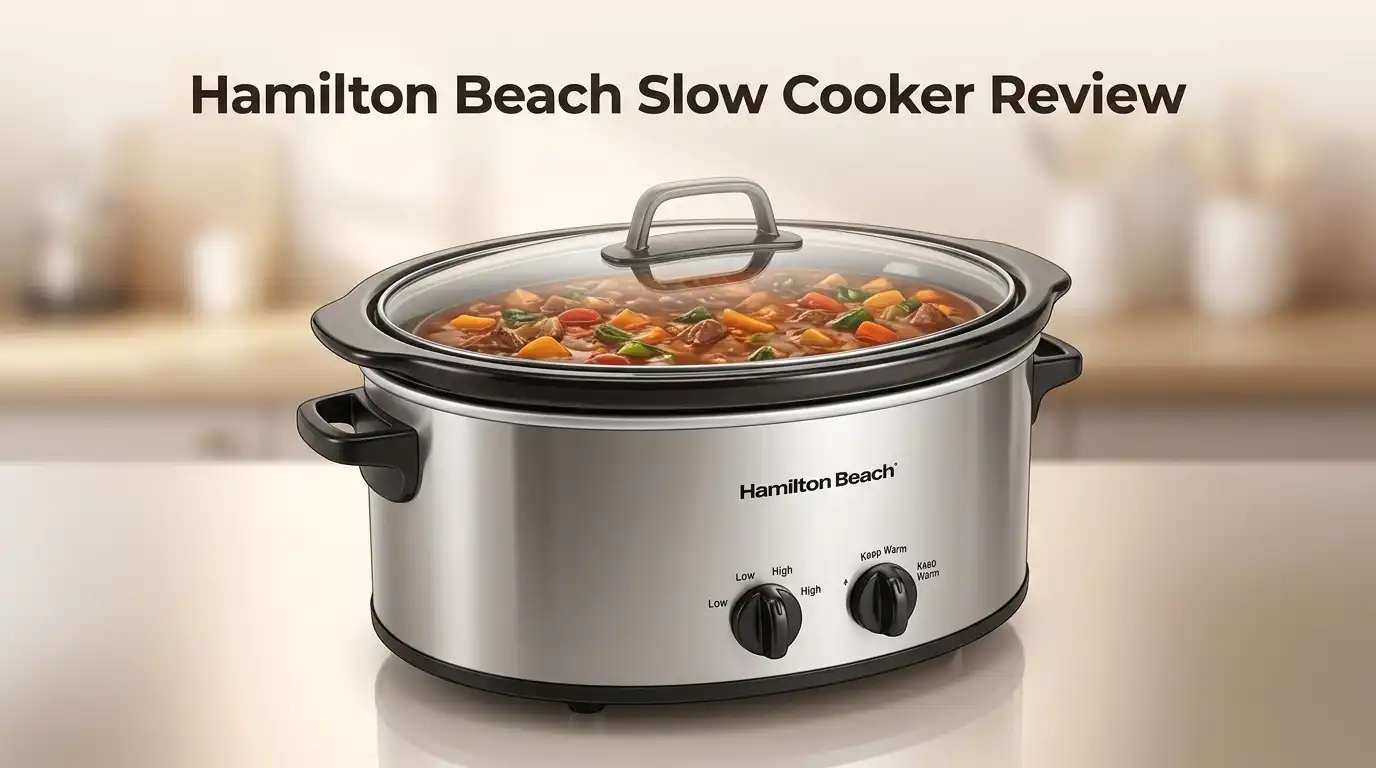
This is model 33969A, the 6-quart oval with the probe, program and manual trio of modes. It is the version most testing sites keep ranking at the top of the category.
The crock is dense ceramic stoneware. It holds heat well and releases it slowly, which is exactly what you want for a long braise.
Capacity is honest. A 6-pound roast fits with room to spare, and I squeezed in a 7-pound pork shoulder without fighting the lid.


Last update on 2026-04-08 / Affiliate links / Images from Amazon Product Advertising API
The base is steel-wrapped plastic with two solid side handles. Empty weight sits around 13 pounds, so this is not a one-hand carry when full.
Three controls matter: the probe jack on the front panel, the backlit LED screen, and the mode selector. Everything else is timing.
Power draw is modest. It sips electricity compared to running an oven for eight hours, which is part of why slow cookers survived the air fryer boom.
Hamilton Beach positions this as a portable cooker. The lid clips and gasket are the reason that word appears, and they are the features I ended up caring about most.
Unboxing And First Impressions
The box is plain brown corrugate with a product photo. No ceremony, no tissue paper, no branded ribbon.
Inside, the crock sits in a molded foam collar with the glass lid nested on top. Mine arrived intact, though the ceramic is the obvious shipping risk.
The probe comes in a small plastic sleeve taped to the manual. It is easy to miss if you tear the box open fast.
First thing I noticed: the ceramic is heavier than it looks. Lifting the empty crock out of the base takes both hands and a bit of intention.
The finish is a matte black exterior with a glossy white interior glaze. It looks plainer in person than in the product photos, which I do not mind.
There is a faint new appliance smell on first heating. It is a light plastic warmth from the base housing, not the crock, and it disappeared after one empty water run.
The gasket is a soft silicone ring seated in a groove around the lid rim. It sits flush and did not shift during handling.
My advice: run a plain water cycle on High for one hour before you cook anything. It clears that manufacturing smell and lets you confirm the seal.
Top 3 Alternatives For The Hamilton Beach Set & Forget Slow Cooker

- Integrated Temperature Probe: Track Your Food’s Temperature With the Probe, Minimizing the Chances of Overcooking and...
- Multiple Cooking Functions: Cook on Low, Medium or High With or Without the Probe; When the Food Is Ready, the Slow...
Last update on 2026-08-09 / Affiliate links / Images from Amazon Product Advertising API
Hamilton Beach Temp Tracker 6 Quart Slow Cooker

- Generous Capacity: 7-quart slow cooker that comfortably serves 9+ people or fits a 7-pound roast
- Cooking Flexibility: High or low slow cooking settings, with convenient warm function for ideal serving temperature
Last update on 2026-06-10 / Affiliate links / Images from Amazon Product Advertising API
Crock-Pot 7-Quart Manual Slow Cooker

- 7 Cooking Functions: Pressure cook, slow cook, sauté, steam, make rice, yogurt, or simply keep your meal warm—all in...
- Customizable Smart Programs: Tackle every recipe with 13 one-touch options, from hearty soups to decadent cakes
Last update on 2026-06-09 / Affiliate links / Images from Amazon Product Advertising API
Instant Pot Duo 7-in-1 Electric Pressure Cooker and Slow Cooker
How The Temperature Probe Actually Works
This is the feature people either love or ignore completely. There is very little middle ground.
You plug the probe into the front jack, push the metal tip through the hole in the lid, and bury it in the thickest part of the meat.
Then you set a target temperature. The cooker heats until the food hits that number, then switches to Warm automatically.
The second use is smarter and less advertised. Submerge the probe in the liquid instead of the meat, and the cooker maintains that liquid temperature all day.
That turns it into a crude sous vide bath or a yogurt incubator. I held 180°F for six hours with no drift I could measure against my own instant-read thermometer.
Accuracy was close. My independent thermometer read within 3 to 4 degrees of the display across three tests, which is fine for braising.
The real limitation is the ceiling. The probe setting stops near 200°F, and collagen-heavy cuts like pork shoulder want a few degrees more.
The workaround: let the probe carry you to 195°F, then switch to manual Low for the final hour. It works, but it defeats the walk-away promise.
Program Mode And Manual Mode Explained
Not every meal needs a probe. Most of mine did not.
Program mode is a straight timer. You pick Low or High, choose a duration, and the machine counts down before dropping to Warm.
Manual mode ignores time entirely. It behaves like a 1980s cooker with three settings and no brain, which is what you want for a party dip.
The dial-and-screen combination is the quiet improvement over older units. The backlit display is readable across a dim kitchen, and the dial beats tapping an up arrow thirty times.
There is one behavior worth knowing. The unit has power interrupt protection, so it remembers your settings through a brief flicker.
A longer outage is different. A full power loss resets the cycle, and you will come home to cold food and a blinking panel.
Timer resolution is coarse. You set hours, not minutes, which is standard for the category but frustrating for delicate recipes.
Beeping is soft. If you are in another room with the TV on, you will miss the end-of-cook alert entirely.
Cooking Performance Across Real Meals
I cooked eight full recipes before writing this section. Results were consistent, with one caveat.
Chuck roast on Low for 7 hours shredded with a fork and stayed genuinely moist. This is the cooker’s best trick.
Chili on Low for 6 hours held a gentle simmer with light bubbling at the edges only. No scorch ring formed on the ceramic.
Dried beans were the caveat. A recipe calling for 8 hours was soft at the 6.5-hour mark and edging toward mush by 7.5.
That matches what I found in owner feedback across forums and retailer reviews. This machine runs a touch hot on Low, as most modern cookers do to satisfy food safety standards.
Steel-cut oatmeal overnight on Low worked, but only with extra liquid. Eight hours evaporates more than the recipe writer assumed.
Boneless chicken breast is the one protein I would not leave unattended. Four hours turned it stringy, and the probe is the only reliable defense.
Heat distribution was even. I found no hot spot directly over the element, which is a benefit of the thick stoneware holding and spreading heat.
Adjust your first three recipes by an hour and you will be fine after that.
The Gasket Lid Clips And Travel Test
This is the feature that justifies the word Portable in the product name.
Two plastic clips fold up and over the lid rim. They snap down with a firm click that you can feel through your fingers.
The silicone gasket compresses between glass and ceramic. It does not create a pressure seal, but it stops the sloshing that ruins car upholstery.
I tested it properly. A full pot of honey-glazed ham travelled 25 minutes on a back seat, and nothing escaped.
The seal has a second benefit indoors. Less steam escapes during long cooks, so overnight recipes lose less liquid.
There is a tradeoff worth naming. Trapped moisture means sauces reduce more slowly, and a watery chili stays watery.
The fix: remove the lid for the last 45 minutes on High if you want a thicker result.
The clips are plastic. They feel sturdy now, but plastic hinges are the classic long-term failure point on appliances like this.
One genuine flaw appears here. If the lid is not seated correctly, the timer stops but the heating continues, which several owners have reported.
Cleaning Storage And Daily Handling
Cleanup is the daily reality of owning a slow cooker, and it drives more regret than cooking performance does.
The stoneware crock is dishwasher safe and fits most lower racks, though it eats a lot of space.
The glass lid is dishwasher safe too. The gasket stays in its groove through a cycle, but check it afterward.
Hand washing is easier than it sounds. The glaze releases stuck-on food after a 20-minute soak with warm soapy water.
The probe is hand wash only. Wipe the metal stem and keep the plug end dry, or you will kill it.
The base wipes clean with a damp cloth. Never submerge it, and never pour liquid into an empty base.
Storage is the honest problem. The oval footprint runs roughly 17 inches wide, and it does not slide neatly into a standard cabinet.
Ceramic warning: do not pour cold liquid into a hot crock or set the hot crock on a cold counter. Thermal shock cracks stoneware, and that damage is not a warranty claim.
Pros And Cons
Here is the honest ledger after several weeks of daily use.
Pros
- The temperature probe removes guesswork from large cuts of meat and doubles as a liquid-temperature controller for yogurt and low-temperature holding.
- The clip-tight gasket lid actually prevents travel spills, which makes potlucks and tailgates realistic rather than stressful.
- Dense ceramic stoneware heats evenly with no detectable hot spot, and both crock and lid go in the dishwasher.
- Capacity is generous. A 6-pound roast fits comfortably, and the pot serves a family of five with leftovers.
- Pricing sits at the low end of the category despite features that appear on machines costing twice as much.
- The backlit LED display and dial are easier to read and operate than the button panels on older models.
Cons
- The probe stops near 200°F, which is short of the temperature pulled pork fans want.
- It runs slightly hot on Low, so older recipes need adjustment and lean proteins need watching.
- At 13 pounds empty, it is awkward for anyone with limited grip strength or wrist pain.
- The crock is not stovetop safe, so browning meat means dirtying a second pan.
- A full power outage wipes the program, unlike a mechanical dial cooker.
- The end-of-cook beep is quiet and easy to miss from another room.
Who Should Skip This Slow Cooker
I would rather lose a sale than see someone buy the wrong appliance.
Skip it if you sear everything first. The ceramic crock cannot go on a burner, so you will always dirty a skillet.
Skip it if your counter space is tight. The oval footprint is wide, and the height clears most upper cabinets by very little.
Skip it if lifting is difficult. A hot, full crock weighs a serious amount, and arthritis or wrist injuries make that a genuine hazard.
Skip it if you cook for one or two. Slow cookers perform best when at least half full, and a 6-quart pot needs volume to behave.
Skip it if you want speed. A pressure cooker finishes beans in 40 minutes; this machine finishes them in six hours.
Skip it if you already own a probe thermometer you trust. Half the value here is the probe, and paying for a duplicate makes little sense.
There is one more group. If you cook mostly delicate fish, vegetables or lean chicken, a slow cooker of any brand is the wrong tool.
Price Warranty And Long Term Value
- NOT YOUR MOM’S SLOW COOKER: Smart technology allows you to cook a recipe to either a desired cooking time or specific...
- PATENTED TEMPERATURE PROBE: Place the temperature probe into large cuts of meat to cook to a precise temperature. The...
Last update on 2026-07-11 / Affiliate links / Images from Amazon Product Advertising API
Pricing has hovered in the $60 to $80 range, with frequent dips during holiday sales.
That is remarkable for a probe-equipped cooker. Comparable machines with a built-in thermometer routinely cost double or more.
Hamilton Beach covers the unit with a limited warranty, typically one year on the appliance against manufacturing defects.
Replacement crocks and lids are sold separately. That matters, because ceramic is the part most likely to break first.
Long-term durability looks reasonable based on owner reports spanning several years. The failures I found clustered around the control board and the plastic lid clips, not the heating element.
Value depends entirely on whether you use the probe. Ignore it and you have paid extra for a very good basic cooker.
Use it weekly and the calculation changes fast. Consistent pulled pork and unattended overnight cooking are worth real money to a busy household.
My verdict: worth buying, provided you have the counter space and you adjust your first few recipes for a machine that runs hot.
Frequently Asked Questions
Does the Hamilton Beach Set & Forget cook too hot on Low?
It runs slightly hot, yes. Recipes written for older cookers often finish 30 to 90 minutes early, especially beans and lean poultry.
This is an industry-wide shift. Manufacturers raised temperatures so food clears the bacterial danger zone faster.
Practical fix: check your dish an hour before the recipe says, and add liquid generously on overnight cooks.
Can the probe reach the temperature needed for pulled pork?
Not entirely. The probe setting caps near 200°F, while classic pulled pork wants roughly 203°F for full collagen breakdown.
The shortfall is small. Take the meat to 195°F on the probe, then run manual Low for another 45 to 60 minutes.
Most owners report the result is indistinguishable from a full 203°F cook.
Is the crock actually dishwasher safe?
Yes. Both the stoneware crock and the glass lid are rated for the dishwasher, and mine survived repeated cycles without glaze damage.
The probe is not. Wipe it by hand and keep the connector end completely dry.
Avoid thermal shock. Let the crock cool before it meets cold water.
Can I really transport it without spilling?
This is the feature that surprised me most. The gasket and two side clips held a full pot of glazed ham through a 25-minute drive.
It is not airtight and it is not tip-proof. Keep it level, use the side handles, and place it on a flat floor rather than a seat if you can.
What happens during a power outage?
A brief flicker is fine. The unit has power interrupt protection and resumes its cycle.
A longer outage is a different story. The program clears and cooking stops, so food left for hours afterward should be discarded rather than reheated.
How does it compare to an Instant Pot on slow cook mode?
An Instant Pot slow cooks acceptably, but its metal pot heats from the bottom only and lacks the even, gentle radiance of thick ceramic.
The Instant Pot wins on speed and versatility. This cooker wins on texture, capacity and travel.

Hi, I’m Liza Jensen, your culinary companion here at Recipe by Liza. 🍳🥗Cooking has always been my passion—I find joy in every whisk, every sizzle, and every aromatic spice. As a home cook and recipe developer, I’ve explored flavors from around the world, creating dishes that warm hearts and tantalize taste buds.Join me on this flavorful journey! Let’s swap kitchen stories, share tips, and celebrate the magic of food together.