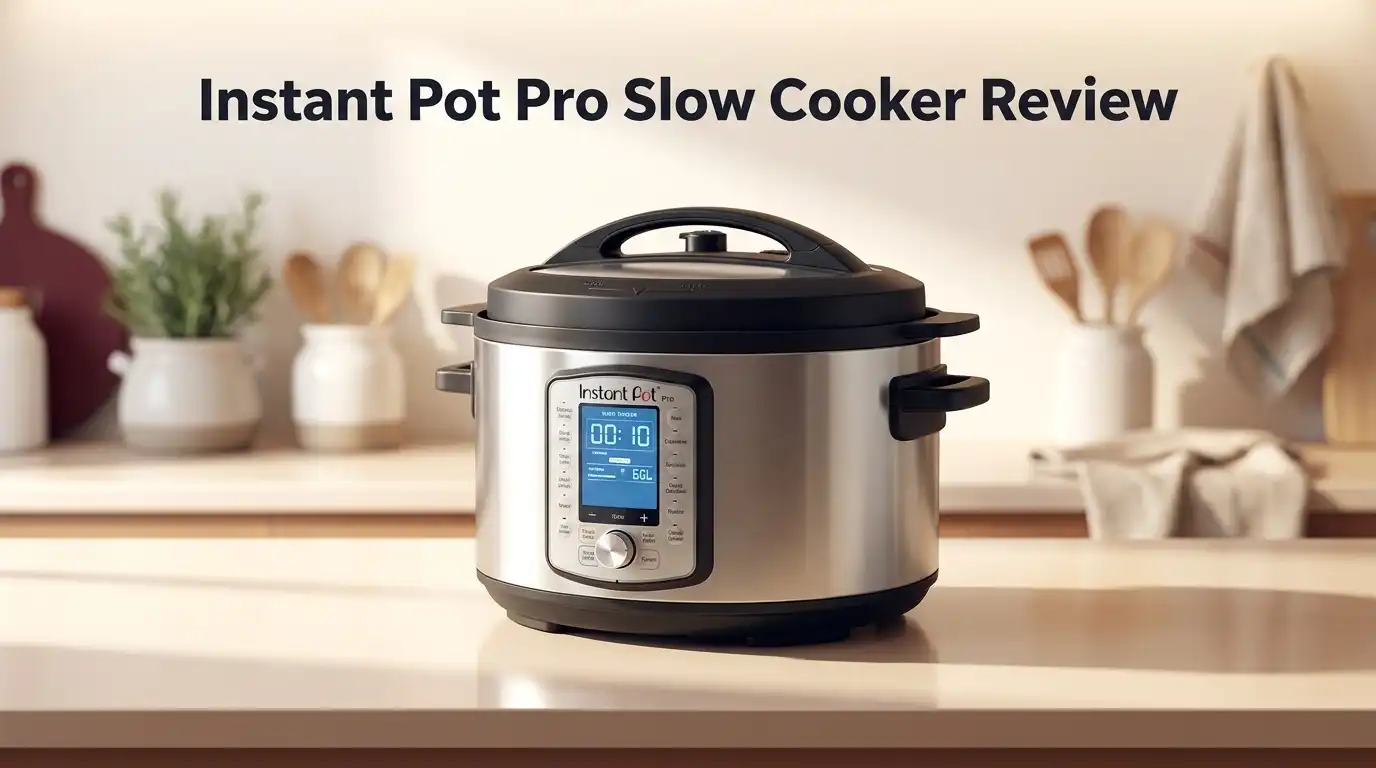
Instant Pot Pro Slow Cooker Review 2026: Crockpot Killer?
You bought a multi-cooker to clear counter space. Then you pressed Slow Cook, walked away for eight hours, and came home to lukewarm beef and crunchy carrots.
That single disappointment sends thousands of people back to the store for a dedicated crockpot every year. It is the most common complaint about this appliance, and it deserves a straight answer.
I have run the Instant Pot Pro through chilis, chuck roasts, bone broth, and split pea soup using only the slow cook function. Some batches were excellent. Some were genuinely bad. The difference came down to three variables nobody prints on the box.
In a Nutshell
- The slow cook function works, but it is not a crockpot swap. The Pro heats from the bottom only, while a traditional slow cooker heats the base and the walls. That single design difference changes everything downstream.
- Liquid is the heat carrier here. Recipes with two cups or more of broth, stock, or sauce come out excellent because the liquid does the job the ceramic walls would normally do. Dry recipes fail.
- The Pro only offers Low and High, unlike older Duo models with Less, Normal, and More. High is the setting you want for almost everything. Low behaves closer to a warming setting.
- Add fifteen minutes per hour to any crockpot recipe you convert. A four-hour crockpot braise needs roughly five hours here.
- The stainless steel inner pot is the tradeoff. It is dishwasher safe, oven safe, and lets you sear directly in the pot, but it holds heat far worse than stoneware.
- Best for: cooks who mainly pressure cook and want slow cooking as a backup. Worst for: anyone whose primary need is genuine low-and-slow braising.
Instant Pot Pro 10-in-1 Multi-Cooker

- 10 Cooking Functions: Pressure cook, slow cook, sous vide, sauté, sterilize, cook yogurt and rice, bake, steam, or...
- Customizable Smart Programs: Tackle every recipe with 28 one-touch options covering all essential meals

Last update on 2026-06-09 / Affiliate links / Images from Amazon Product Advertising API
The Pro is the mid-tier model in the current lineup, sitting above the Duo and below the smart, app-connected versions. It carries ten programs, including pressure cook, slow cook, sous vide, sauté, steam, rice, yogurt, bake, sterilize, and keep warm.
The 6-quart version suits households of two to four. The 8-quart handles batch cooking and larger roasts better, and it also slow cooks slightly more evenly because the wider base puts more food in direct contact with the heat.


Last update on 2026-04-08 / Affiliate links / Images from Amazon Product Advertising API
Wattage sits at 1000W for the 6-quart. That is respectable for pressure cooking and modest for slow cooking, which explains a lot of the temperature complaints.
The build is genuinely good. The lid stores upright in the handle slots, the steam release is a quiet, one-handed switch rather than the old jiggling valve, and the control panel is backlit and readable in a dim kitchen.
Nothing here is flimsy. The question is whether a very good pressure cooker can moonlight as a decent slow cooker.
Unboxing, Texture, and Everyday Handling
The box is compact and the unit comes out in one lift. Inside you get the cooker, the stainless steel inner pot, a wire trivet, a condensation collector, and a spare sealing ring.
There is no tempered glass lid included, which matters more than it sounds. I will come back to that.
First impressions are solid rather than luxurious. The exterior is matte black with a brushed steel band, and it resists fingerprints better than the glossy older models.
New units carry a faint plastic and machine-oil smell for the first two runs. A water-only steam cycle clears it completely.
The inner pot has a mirror-finish interior with etched fill lines. Food releases well once the pot is seasoned by a few sauté sessions, though the first tomato-heavy batch will stain slightly.
Cleanup is the quiet win. The pot goes in the dishwasher, the sealing ring pops out, and the lid rinses clean in under a minute. A traditional stoneware crock is heavier, more fragile, and much harder to lift when full.
Handles stay cool. The silicone grips let you carry a full pot without a towel.
How the Slow Cook Setting Actually Works
Press Slow Cook, choose Low or High, then set your duration from thirty minutes up to twenty hours. The unit begins cooking about ten seconds after your last button press.
Here is the part that confuses people. The display shows a preheating stage that ignores the actual pot temperature, and the cook timer starts counting immediately regardless.
That means your “eight-hour” cook includes a slow ramp-up that a crockpot would have finished far earlier. You are losing real cooking time to a warm-up phase you cannot see.
Measured temperatures tell the rest of the story. Low runs roughly 170 to 190°F. High runs closer to 190 to 210°F.
A traditional crockpot’s low setting sits around 190 to 200°F, and its high setting reaches 225 to 275°F. So Instant Pot High is roughly equivalent to crockpot Low, and Instant Pot Low is closer to a warming drawer.
Once you accept that mapping, the appliance stops feeling broken. It is simply running one full setting cooler than you expected.
Top 3 Alternatives for the Instant Pot Pro

- Serves 10+ people
- 8-quart capacity
Last update on 2026-08-01 / Affiliate links / Images from Amazon Product Advertising API
Crock-Pot 8-Quart Manual Slow Cooker

- REPLACE 14 KITCHEN APPLIANCES IN ONE POT: This 8.5 qt multi-cooker handles slow cooking, Dutch oven, searing, sautéing...
- 8 COOKING FUNCTIONS: Slow Cook, Sear/Sauté, Steam, Keep Warm, Sous Vide, Braise, Bake, and Proof.
Last update on 2026-09-19 / Affiliate links / Images from Amazon Product Advertising API
Ninja PossibleCooker PRO 14-in-1, 8.5-Quart

- NOT YOUR MOM’S SLOW COOKER: Smart technology allows you to cook a recipe to either a desired cooking time or specific...
- PATENTED TEMPERATURE PROBE: Place the temperature probe into large cuts of meat to cook to a precise temperature. The...
Last update on 2026-07-11 / Affiliate links / Images from Amazon Product Advertising API
Hamilton Beach Set & Forget 6-Quart Programmable Slow Cooker
Real Cook Times and Honest Results
My chuck roast test is the one that separates the marketing from reality. Three pounds of bone-in chuck with two cups of beef stock, onions, and carrots.
On High for eight hours, the meat pulled apart cleanly and the vegetables were tender. On Low for eight hours, the same cut was cooked through but still firm and stringy.
Soups and chilis performed best across every test. Split pea, chicken tortilla, and white bean stew all finished ahead of schedule because the liquid volume transferred heat efficiently.
Dry-style recipes failed. A rack of dry-rubbed ribs with only a half cup of liquid produced a scorched bottom layer and pale, undercooked meat on top.
The conversion math that actually worked for me: take your crockpot low time, run it on High, and add fifteen minutes for every hour. A six-hour crockpot recipe becomes roughly seven and a half hours here.
One more trick that changed my results permanently. Run Sauté for five minutes first to bring cold ingredients up to temperature before switching to slow cook. It removes the dead ramp-up period entirely.
The Stainless Steel Pot Problem
Ceramic and stoneware are poor conductors, and that is precisely why slow cookers use them. The crock absorbs heat slowly, then radiates it back into the food from every direction for hours.
Stainless steel does the opposite. It conducts heat quickly, holds almost none of it, and only transfers warmth from the heated base plate.
The practical effect is stratification. In a half-full pot with chunky ingredients, the bottom layer cooks properly while the top layer sits well below a safe simmer.
This is why large-volume, low-liquid recipes are the weak point. There is nothing carrying heat to the food sitting above the waterline.
The workaround is straightforward but limiting. Fill the pot no more than two-thirds and make sure liquid reaches at least halfway up your ingredients.
There is a real upside to the steel, though. You can brown meat, deglaze, reduce a sauce, and slow cook in the same vessel, and then put the whole pot in the oven up to 350°F. No stoneware crock does that.
The Lid Situation Nobody Mentions
The Pro ships with its pressure lid only. That lid is engineered to seal, not to breathe.
Slow cooking needs some evaporation to concentrate flavor and thicken sauces. Seal the lid and you trap every bit of moisture, which leaves stews thin and watery.
The manual tells you to set the valve to Venting during slow cook. That helps, but the narrow vent releases far less steam than a loose glass lid would.
I bought a tempered glass lid with a stainless rim for under twenty dollars and it improved results immediately. Sauces reduced properly, and I could check progress without lifting anything.
Treat the glass lid as a required purchase rather than an accessory. Budgeting for the cooker without it gives you an incomplete picture of the real cost.
One small caution some users share online: sealing the pressure lid during slow cook does not build pressure on this model, but I would not recommend the habit. Venting or glass is the safe path.
Where the Pro Genuinely Beats a Crockpot
Fairness matters, and the Pro wins several rounds outright.
Searing in the pot is the biggest one. Browning meat builds flavor that no slow cooker can create on its own, and doing it without a second pan saves a real cleanup step.
Finishing power is the second. If your roast is still tough at hour seven, you can seal the lid and pressure cook it for twenty minutes to rescue dinner. A crockpot leaves you waiting and hoping.
Storage is the third. The inner pot fits in most refrigerators, so leftovers stay in the same vessel with a sealed silicone or plastic cover.
Reduction is the fourth. Pull the meat out, hit Sauté, and reduce the braising liquid into a proper gravy in the same pot.
Then there is the counter-space argument. One appliance replacing a pressure cooker, rice cooker, yogurt maker, and occasional slow cooker is a legitimate benefit in a small kitchen.
None of this makes it a better slow cooker. It makes it a better overall cooking tool that happens to slow cook adequately.
Who Should Skip This Cooker
Be honest about your habits before you buy.
Skip it if slow cooking is your main method. If you make pot roast, pulled pork, or pulled chicken three times a week, a stoneware crockpot will produce better texture for a third of the price.
Skip it if you cook dry recipes. Slow cooker lasagna, baked potatoes, dinner rolls, and dump-style casseroles need dry radiant heat that this pot cannot deliver.
Skip it if you leave the house all day and need certainty. The slow ramp-up and cooler ceiling mean an unattended eight-hour cook is a gamble unless you have tested that exact recipe.
Skip it if you slow cook dried beans. Beans contain a natural toxin that requires a hard boil to break down, and this setting does not reliably reach that temperature. Pressure cook them instead.
Skip it if you dislike menus. The control panel has multiple layers, and pressing Slow Cook then adjusting temperature before closing the lid is not obvious on day one.
Buyers who primarily pressure cook and want a fallback for soup nights will be happy. Everyone else should reconsider.
Pros and Cons
Pros
- Excellent pressure cooker first and foremost, with a quiet, one-handed steam release and a genuinely quick preheat.
- Stainless steel inner pot is dishwasher safe, oven safe to 350°F, and fridge friendly, which stoneware crocks are not.
- Sauté and slow cook in one vessel means real browning and real sauce reduction without a second pan.
- Slow cook timer runs up to twenty hours with automatic transition to Keep Warm.
- Handles stay cool, the lid stores upright in the side slots, and the build feels durable after months of use.
- Liquid-heavy recipes like soups, chilis, and stews turn out consistently well.
Cons
- Heats from the bottom only, producing uneven results in large or chunky batches.
- Runs one full setting cooler than a traditional slow cooker, so recipe conversion is mandatory.
- No glass lid included, and the pressure lid traps too much moisture even on Venting.
- The preheat display is inaccurate and the timer starts before the pot is hot.
- Low setting is close to useless for actual cooking.
- Poor performance with dry recipes and dried beans.
- Costs considerably more than a capable dedicated slow cooker.
The Verdict for 2026
- 10 Cooking Functions: Pressure cook, slow cook, sous vide, sauté, sterilize, cook yogurt and rice, bake, steam, or...
- Customizable Smart Programs: Tackle every recipe with 28 one-touch options covering all essential meals.
Last update on 2026-06-09 / Affiliate links / Images from Amazon Product Advertising API
The Instant Pot Pro is not a crockpot killer. It is a very good pressure cooker with a competent slow cook backup, and the honest framing changes whether you feel cheated or satisfied.
Buy it if you want one appliance that does eight things well and one thing acceptably. Set it to High, add liquid, add time, and buy the glass lid.
Do not buy it as a slow cooker replacement. A $30 stoneware crockpot will beat it at low-and-slow braising every single time, and the two appliances work beautifully as a pair.
The 8-quart is my pick if you have the counter space, purely because the wider heating base slow cooks more evenly than the 6-quart.
Value depends entirely on your cooking style. For pressure-cooking households, it is money well spent. For dedicated slow cookers, it is an expensive compromise.
Expert FAQs
Can the Instant Pot Pro replace my crockpot completely?
Not for every recipe. It handles soups, stews, chilis, and liquid braises well but struggles with dry recipes and large low-liquid batches. Most experienced users keep both appliances.
Which slow cook setting equals crockpot low?
High on the Instant Pot Pro is roughly equivalent to Low on a crockpot. The Pro’s Low setting sits near warming temperatures and should not be used for raw ingredients.
How much liquid do I need for slow cooking?
Use at least two cups. The liquid transfers heat to food above the base, replacing the job that stoneware walls perform in a traditional cooker.
Should the valve be sealed or venting during slow cook?
Venting. Slow cooking needs evaporation to concentrate flavor. A tempered glass lid works better than the pressure lid for this purpose.
Why does my food take longer than the recipe says?
Two reasons. The pot runs cooler than a crockpot, and the timer begins before the contents are hot. Add fifteen minutes per hour to any converted recipe.
Is the 6-quart or 8-quart better for slow cooking?
The 8-quart performs better. Its wider base puts more food in contact with the heating element, which reduces the uneven cooking that affects the smaller model.

Hi, I’m Liza Jensen, your culinary companion here at Recipe by Liza. 🍳🥗Cooking has always been my passion—I find joy in every whisk, every sizzle, and every aromatic spice. As a home cook and recipe developer, I’ve explored flavors from around the world, creating dishes that warm hearts and tantalize taste buds.Join me on this flavorful journey! Let’s swap kitchen stories, share tips, and celebrate the magic of food together.